


The Dealership Marketing Scorecard a General Manager Can Use
The Dealership Marketing Scorecard a General Manager Can Use
The Press Box All the news thats fit to dance to| September 2026 | Draft for Review
A useful scorecard turns campaign activity into an operating decision.
The Short Answer
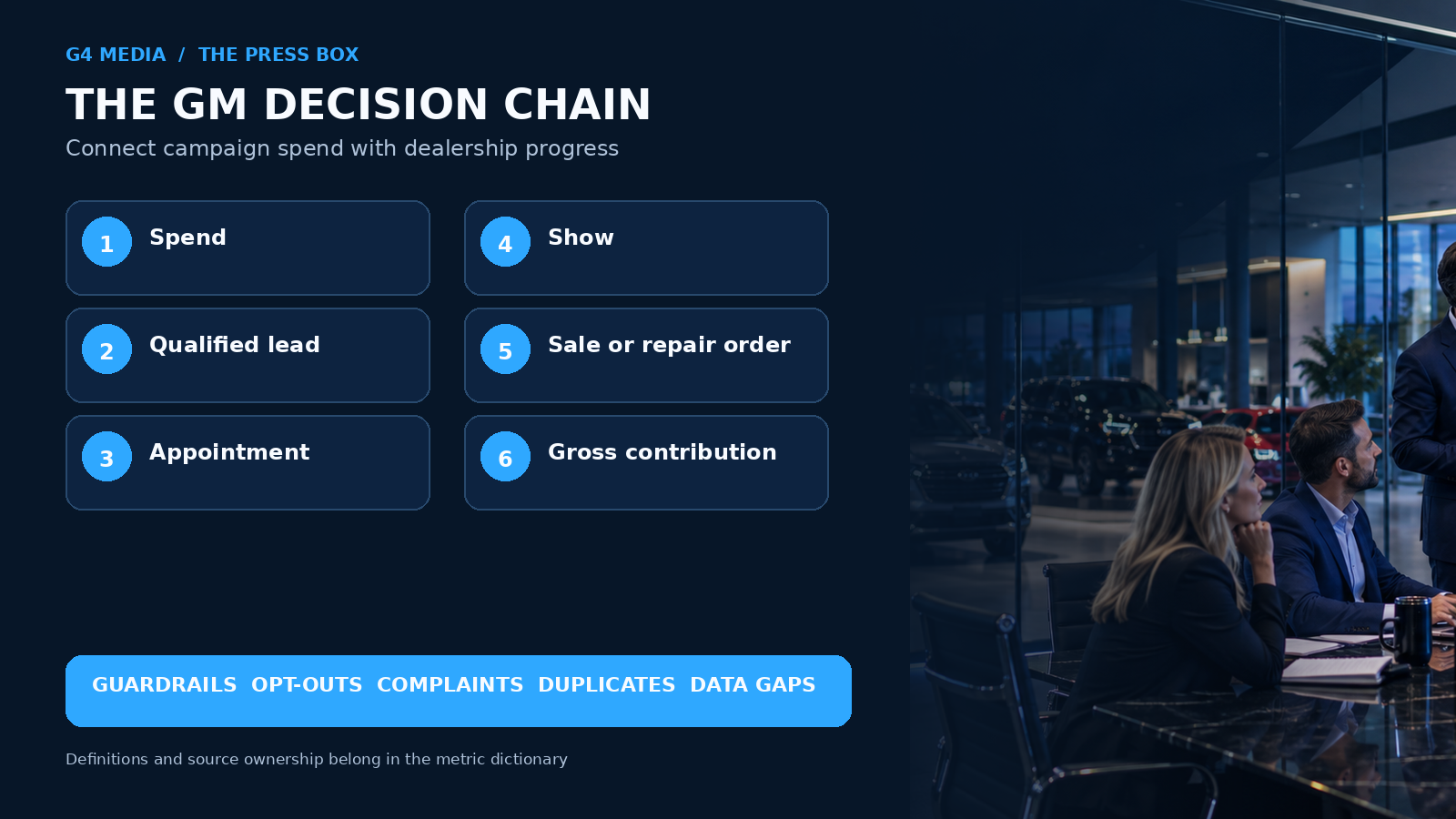
A useful dealership marketing scorecard connects spend to business progression: qualified lead, appointment, show, sale or repair order, and gross contribution. It shows both counts and conversion rates, uses a written definition for every stage, identifies the source system and reporting delay, and displays trust indicators such as opt-outs, complaints, duplicates, and missing data.
The scorecard should fit on one page because its purpose is to support decisions, not to reproduce every platform dashboard. A general manager should be able to see where volume entered, where it stalled, what the outcomes were, and which data cannot support a firm conclusion. Channel metrics such as impressions, clicks, scans, and matched records remain useful diagnostics, but they should not be presented as interchangeable with appointments or sales. Build one operating view, review it on a consistent cadence, and give every unexplained break in the chain an owner.

Start With the Decision Chain
The scorecard should reflect how the dealership actually sells and services vehicles. Map the minimum stages that management uses to allocate people, inventory, and budget.
For a sales campaign, the chain might be:
Spend to qualified lead to appointment to show to sale to gross contribution.
For a fixed-operations campaign, it might be:
Spend to response to scheduled visit to completed repair order to customer retention value.
The words are less important than the definitions. A qualified lead should not mean one thing in the CRM, another thing in a vendor report, and a third thing in the weekly meeting. A show should not include an unverified status. A sale should use a consistent transaction date and exclusion rule.
Create a metric dictionary with the name, definition, owner, source, update cadence, exclusions, and known limitations. That small document prevents many arguments that appear to be about performance but are actually about inconsistent counting.
Show Volume and Rate Together
Counts show operational load. Rates show progression. Both are necessary.
A channel can generate many leads and a weak appointment rate. Another can generate fewer leads but stronger shows and sales. Neither result is understandable without cost, sample size, timing, source quality, and the store's capacity to work the response.
Use a small set of rows.
| Stage | Count | Rate | Cost | Owner question |
|---|---|---|---|---|
| Qualified leads | Actual | From delivered reach or response | Cost per qualified lead | Did the offer reach the intended audience |
| Appointments | Actual | Appointments divided by qualified leads | Cost per appointment | Did the team create a clear next step |
| Shows | Actual | Shows divided by appointments | Cost per show | Was the appointment confirmed and credible |
| Sales or repair orders | Actual | Outcomes divided by shows | Cost per outcome | Did inventory, offer, and desk process deliver |
| Gross contribution | Approved value | Per outcome where appropriate | Return measure | Did the campaign create acceptable economics |
Do not force a false precision when data is late or incomplete. Mark missing results, late DMS updates, unmatched records, and estimated gross instead of quietly substituting zeros or averages.
Reconcile the Systems
Media platforms, call tracking, landing pages, CRM, DMS, and vendor matchback files observe different events. Their totals will not always agree, and that is not automatically a failure. The team needs a rule for which system governs each stage and how duplicates are handled.
Google's official offline-conversion guidance explains how advertisers can connect an ad interaction to a later offline event[cite: 1]. Its September 2026 guidance also recommends enhanced conversions for leads for new implementations and describes the use of hashed first-party data. These tools can improve measurement, but they do not replace consent, data governance, sound CRM process, or an incrementality design.
G4 Media lead conversion and identity resolution can support the connection between anonymous activity, known responses, and downstream outcomes. G4 digital media can use the agreed conversion definitions for activation and optimization. The scorecard should remain management's common operating view across those systems.
Add Trust and Capacity Guardrails
Performance without quality controls can create a misleading green dashboard. Add a compact guardrail section with opt-outs, complaints, invalid contacts, duplicates, bad addresses, unreachable leads, average response time, missing source data, and any active tracking incident.
Capacity also belongs in the conversation. If appointment volume rises while response time deteriorates, more media may make the customer experience worse. If an offer draws interest for unavailable inventory, the top of the funnel can look healthy while the store loses credibility.
Set thresholds that trigger a review, not automatic blame. A data-quality warning should lead to diagnosis: source, routing, staffing, inventory, creative, customer expectation, or measurement may be responsible.
Run a Weekly Decision Meeting
Use the same scorecard each week and add only the context needed to choose an action.
-
Confirm data freshness and known incidents.
-
Review outcomes and economics first.
-
Locate the biggest break in progression.
-
Separate a marketing issue from a capacity, inventory, or process issue.
-
Assign one owner, action, expected effect, and review date.
-
Record what changed so the next report can evaluate it.
Avoid spending the meeting debating platform-specific credit. Attribution detail can be reviewed separately. The general manager's question is whether the coordinated system created valuable customer progress at an acceptable cost.
The G4 Media View
Good reporting makes coordinated marketing governable. G4 can help define the audience, deploy direct and digital touchpoints, build response paths, and reconcile campaign outcomes. The dealership contributes the operational definitions, timely CRM and DMS practices, and decision ownership that make the numbers useful.
If the weekly report is long but the next action is unclear, talk with G4 Media about a one-page campaign scorecard tied to dealership outcomes.
Risks and Limits
-
A matched or platform-attributed conversion is not automatically an incremental outcome.
-
Gross and return calculations require consistent accounting rules and approved data access.
-
CRM status quality can materially change conversion rates.
-
Privacy, consent, contractual, and platform requirements apply to customer data and conversion uploads.
-
Small samples and reporting lags can distort short-term comparisons.
-
One-page management reporting should link to, not replace, deeper diagnostic detail.
Frequently Asked Questions
What belongs on a dealership marketing scorecard
Include spend, qualified leads, appointments, shows, sales or repair orders, gross contribution where approved, conversion rates, cost per stage, and quality guardrails.
Should impressions and clicks be included
Yes, when they help diagnose reach or creative response. Keep them secondary to meaningful dealership progression and outcomes.
Why do vendor and CRM totals disagree
They may use different identities, windows, timestamps, exclusions, sources, and attribution rules. Document the differences and choose a governing system for each stage.
How often should management review it
Weekly is useful for active campaigns, with monthly and campaign-close reviews for more stable economic conclusions. Match the cadence to data freshness.
What is the first metric to fix
Fix the largest credible constraint closest to the business outcome, but check data quality before treating a reported rate as an operational fact.
Sources
-
Google Ads offline conversion import guidance Official explanation of connecting ad interactions with later offline events and 2026 implementation changes[cite: 1].
-
Google Ads enhanced conversions guidance Official explanation of hashed first-party data and conversion measurement.
-
Federal Trade Commission automobile industry resources Current federal automotive enforcement and business guidance.
Recent Posts