

You Won the Vehicle Sale. G4 Media Helps You Build the Service Relationship That Comes Next.
The Press Box | All the news that’s fit to dance to
Illustrative AI-generated scene. Not a photograph of a G4 client or location.
The customer drives away, the sale is recorded and the dealership celebrates. Months later, the service department has never seen that vehicle. Somewhere between delivery and the first maintenance decision, the relationship lost momentum.
The problem is not always dissatisfaction. The owner may never have met an advisor, understood what happens next or received a relevant reminder. A store can spend heavily to earn the initial purchase and leave the ownership relationship to chance.
G4 Media’s Service Suite explicitly addresses customers who purchased but have not returned for service, alongside other retention groups. Our recommendation is to use that retention perspective earlier: make the delivery-to-service handoff a defined part of the customer journey, then identify and address gaps before they become a pattern.
A sale and a service relationship are different milestones
Buying from the dealership does not automatically explain why the owner should return for maintenance. Delivery may be full of paperwork, vehicle orientation and practical arrangements. A quick “Our service department is here when you need us” can disappear among those details.
The handoff needs to answer three simple questions: Who will help me? How will I know what is appropriate for my vehicle? How do I arrange the next step?
Treat those answers as the start of a communication plan. A named service contact, a useful owner resource and an agreed action give future messages a recognizable purpose. Without them, the first reminder can feel like an unfamiliar advertisement from a department the customer never met.
Connect G4’s retention focus to the delivery process
The Service Suite overview includes a sold-but-never-serviced segment. That provides a specific reason G4 is raising this issue: customer acquisition and service retention should be planned together.
For a proposed delivery program, the first step is a shared review with sales and fixed operations. Identify what delivery records contain, how the service department receives the handoff and what determines the next message. Confirm the systems and responsibilities before promising an automated sequence.
Keep a reporting segment separate from a maintenance recommendation. A marketing threshold for identifying an unreturned customer does not prove that a particular vehicle is overdue. Vehicle-specific guidance and the owner’s actual history determine what the communication should say.
Give every delivery an appropriate next state
Choose one of three useful outcomes at the handoff: an accepted appointment, an agreed reminder, or a service-team question that needs resolution. The record should make the outcome clear enough for the next person to act.
A booking should include the purpose and a way to change the time. A reminder should record why it is appropriate and the permitted contact method. A clarification should have a named owner rather than remain buried in a free-text note.
This avoids treating “service discussed” as a completed relationship. It also avoids creating appointments merely to satisfy a delivery metric. The goal is an action the customer understands and the service team can support.
Let the vehicle determine the message
The FTC recommends following the manufacturer’s maintenance schedule for the owner’s driving circumstances. Use the actual vehicle, powertrain and relevant history to guide the plan.
A used vehicle with recent maintenance may need a different message from a new delivery. An electric vehicle should not receive an irrelevant oil-change promotion. Where a maintenance program applies, explain the actual covered services and conditions instead of labeling every first visit free.
Keep the technical decision with qualified service staff. Marketing’s job is to make their guidance understandable, timely and easy to act on. That division gives the customer useful information and gives the campaign a credible reason to exist.
Build messages around events, not just elapsed days
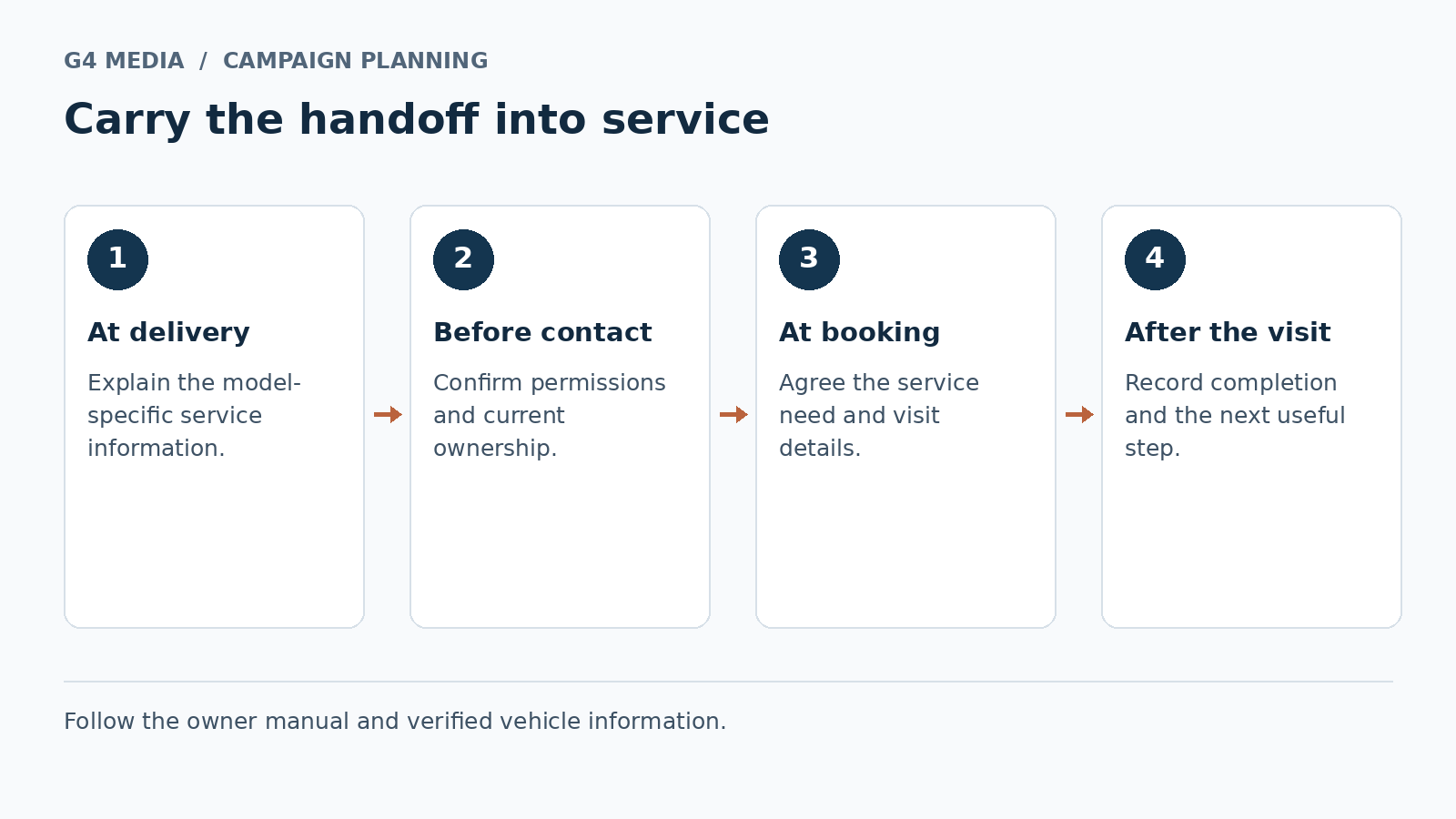
A proposed sequence begins with an introduction after delivery, continues with the appropriate next-step reminder and changes when an appointment is accepted. Once work is completed, the message should acknowledge the new status rather than continue asking for the same visit.
For example, an owner may have agreed to a reminder and then book directly with an advisor before it arrives. If the campaign cannot see the booking, it risks sending an unnecessary prompt. A customer who serviced elsewhere or no longer owns the vehicle needs a different update again.
Test those ordinary situations before expanding the program. Agree on how booking, completion and customer corrections reach the communication process, and how quickly they take effect. Accurate timing can make the difference between helpful follow-up and a message that makes the dealership appear inattentive.
Make the first visit reinforce the promise
The appointment confirmation should explain arrival, the work being discussed and how the advisor will communicate findings. Distinguish a drop-off reservation from a waiting appointment. Make rescheduling easy enough that a changed plan does not quietly become a lost customer.
After the visit, check whether the owner received the experience the delivery message described. If the customer expected included maintenance but received an unexpected charge, the problem may be the earlier explanation. If the vehicle was ready but the owner never heard from the advisor, more promotional messages will not repair the handoff.
The first-service plan therefore needs both campaign ownership and department ownership. G4 can help organize the communications strategy; the dealership must deliver the visit it promises.
Measure the gap before it becomes a habit
Start with a defined group of deliveries and follow the appropriate service opportunities. Track complete handoffs, accepted appointments, attended visits and completed repair orders. Separate customers whose service opportunity has not arrived from those who were eligible and did not return.
Use the store’s current financial definitions when reviewing repair-order results. G4’s retention offering connects completed visits to repair-order revenue, but a matched visit is not automatically proof that the campaign alone caused it. Keep the relationship outcome and the attribution claim distinct.
Review missing records and missed opportunities with the teams responsible. A better process can then be carried into future deliveries, while a separate recovery campaign addresses owners who have already drifted away.
Frequently asked questions
Should every buyer book service before leaving?
Offer an appropriate action. An accepted booking, a later reminder or a service-team clarification can each be the right result for the vehicle and owner.
Does the Service Suite segment define when maintenance is due?
No. It identifies a marketing and retention group. Actual maintenance guidance must reflect the vehicle, applicable manufacturer information and service history.
Can this work with our existing systems?
That should be assessed during planning. Confirm the available data, handoffs and integration scope before assuming updates will happen automatically.
What if the owner already completed service elsewhere?
Update the record through the service department and agree on an appropriate future step. Stop sending an inaccurate reminder for completed work.
What should management review first?
Handoff completeness and accurate customer status. Those measures reveal whether the program has a dependable foundation before evaluating longer-term retention.
Related reading: Why More Leads Will Not Fix Dealer Follow-Up.
Make delivery the beginning of the next relationship
Ask G4 Media to review your delivery-to-service journey with sales and fixed operations. Bring the delivery process, first-service communications and unreturned-customer report together, then build a plan that keeps the dealership useful after the sale.
Recent Posts