



The Customer Said “Not Today.” G4 Media Helps Dealerships Build a Better Declined-Service Follow-Up.
The Press Box | All the news that’s fit to dance to
Illustrative AI-generated scene. Not a photograph of a G4 client or location.
An advisor explains recommended work. The owner postpones it. The repair order closes, and the next communication is either a generic discount or nothing at all. The dealership sees an unapproved recommendation; the customer may still have an unanswered question.
That gap deserves a more useful response. Someone who needs time, someone who does not understand an estimate and someone who completed the work elsewhere should not receive the same message. Treating all three as lost sales wastes effort and can weaken trust.
G4 Media’s fixed-operations and service-retention focus makes this an important marketing issue. Our recommended declined-service strategy starts with the reason behind the decision, then connects a clear explanation, an appropriate response and a measurable next step. It is a proposed campaign approach; the required service data and workflow should be scoped with the dealership.
“Declined” describes a result, not the reason
A declined line item may reflect a scheduling conflict, an unclear recommendation, a price question or a deliberate decision not to proceed. It can also reflect a process gap: perhaps the estimate was incomplete or the customer never had a chance to ask the advisor a question.
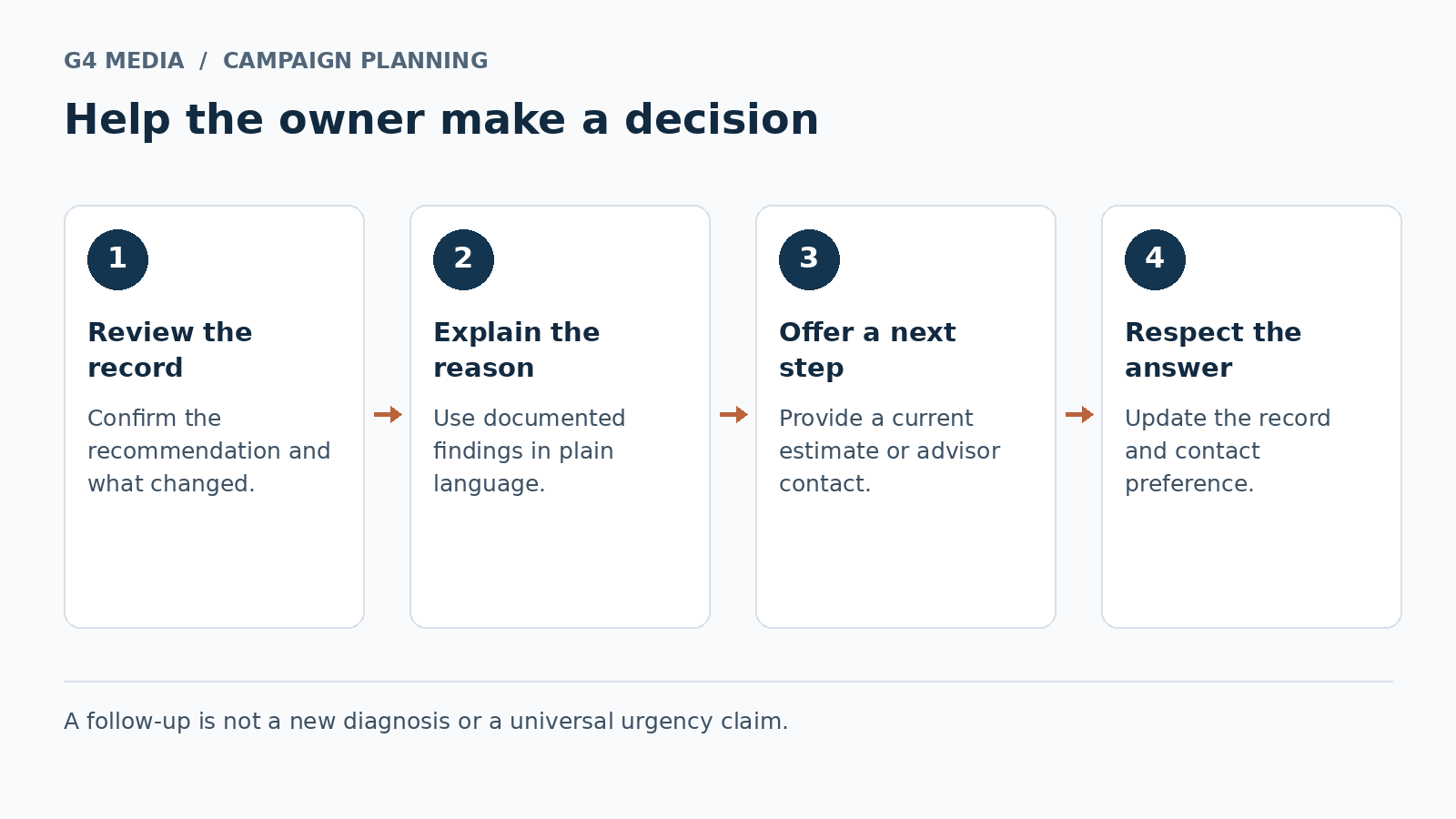
At the original visit, invite the owner to explain the hesitation without pressure. Record a simple, useful reason when they choose to provide one. Avoid speculative labels about financial circumstances or intentions. The record should help the next conversation, not assign a judgment to the customer.
Separate recommendations that remain unresolved from those that were withdrawn, corrected or completed. A follow-up program is only as credible as the status behind its message.
Make the explanation strong enough to support a decision
The customer needs to understand what was found, why the recommendation was made, what the proposed work includes and how to ask a question. The FTC’s repair guidance describes the value of a written estimate identifying the condition, parts and anticipated labor.
Use that customer perspective to review the communication. An internal code or unexplained abbreviation may be familiar to the shop but meaningless to the owner. Where relevant, an approved inspection summary or photograph can support the explanation through the dealership’s secure process.
Qualified service staff must supply technical findings and any urgency. Marketing should not turn every outstanding recommendation into a safety warning. When a serious concern requires direct communication, it should follow the service department’s process rather than wait for a promotional sequence.
Match the next step to the obstacle
For a timing problem, the useful response is a scheduling discussion with realistic options. For an estimate question, clarify the work, included items and current price. For an explanation problem, connect the customer with an advisor who can discuss the finding.
If the work was completed elsewhere, update the active record. If the owner simply does not want to proceed, respect that decision and the applicable contact preferences. An unresolved recommendation does not justify endless messages.
This is where a campaign can become more relevant without becoming more complicated. A small set of accurate reason categories can guide better creative than a large list receiving the same coupon. Start with the categories the department can maintain reliably.
How G4 would turn the record into a useful campaign
The proposed starting point is one recommendation category and a manageable set of eligible records. The service manager verifies the facts and current status; G4 develops messaging around the decision the customer still needs to make.
Our direct-marketing capabilities offer response paths such as landing pages and text response. Select a channel based on the sensitivity of the information, customer permissions and the team’s ability to receive replies. Detailed inspection information belongs in the approved customer system, not on a public page.
Agree on three things before launch: which records qualify, who owns each response and which events stop the sequence. Confirm whether data transfer is manual or integrated. A clear process that staff can execute is more useful than an automation promise nobody has verified.
An example of helping before discounting
Consider an illustrative owner who postponed recommended work because they could not leave the vehicle that day. A later discount might attract attention but still leave the scheduling obstacle unresolved. A message offering a conversation about available appointment arrangements speaks to the reason the work was postponed.
A different owner questioned the scope of the estimate. That person needs an explanation of the work and what the total includes. Sending the same discount risks making the original price seem arbitrary while leaving the substantive question untouched.
These are planning examples, not actual customer cases. They show why G4’s recommended sequence begins with the unresolved decision. An incentive can be considered where appropriate, but it should have a defined role rather than replace the explanation.
Make every reply lead somewhere
A message that invites questions needs a monitored response route. Give the advisor the relevant recommendation and prior context so the customer does not have to reconstruct the entire visit. Distinguish an information request from an appointment request and from authorization to perform work.
Before presenting a price, verify the estimate and any expiration or conditions. Before offering an appointment, verify the shop can handle the work. If a new assessment is needed, explain that step clearly.
Stop or revise routine outreach when work is completed, the customer books, the vehicle is sold, the recommendation is disputed or contact preferences change. Test a few completed and corrected records before a larger campaign. A reminder for work already paid for can undo the credibility of an otherwise thoughtful message.
Measure progress without counting it twice
Track eligible recommendations, meaningful replies, accepted appointments and completed work as separate outcomes. If one vehicle has several recommendations, define whether reporting counts vehicles, repair orders or individual work items.
Also examine incorrect reminders, disputes and opt-outs. These are signals about data quality and relevance. A campaign that reports revenue while ignoring repeated customer corrections is missing part of its own performance.
When reviewing financial outcomes, account for discounts and fulfillment costs using dealership-approved definitions. A later repair may have several influences, including an existing plan or an advisor’s earlier conversation. Report matched outcomes accurately without claiming every dollar was created by the follow-up.
Frequently asked questions
Is every declined recommendation a recovery opportunity?
No. Some work is completed elsewhere, reconsidered or intentionally declined. Verify the current situation before choosing a message.
Should the first message offer a discount?
Only if it addresses a relevant obstacle and fits the campaign economics. An explanation or scheduling conversation may be more useful.
Who decides how urgent the message should be?
Qualified service staff. Marketing communicates their verified guidance and should not invent urgency to increase response.
Is a declined-service integration included in Service Suite?
Do not assume that from the general retention offering. Confirm the specific data, workflow and deliverables with G4 when defining the program.
What makes a good pilot?
One clear recommendation category, accurate records, an advisor who owns replies and a way to identify appointments and completed work.
Give the customer a reason to reopen the conversation
Ask G4 Media to plan a declined-service follow-up with your service team. Start with one unresolved customer question and build the message, response path and measurement around helping the owner answer it.