



Your Reviews Are Writing Your Next Campaign. G4 Media Helps Dealerships Read the Signals.
The Press Box | All the news that’s fit to dance to
Illustrative AI-generated scene. Not a photograph of a G4 client or location.
A dealership promotes an easy service experience. Recent reviews repeatedly describe uncertainty about completion times. Another campaign promises a prepared sales visit, while customers say they arrived and had to restart the conversation. The advertising and the experience are telling different stories.
That mismatch is a marketing problem even when the average star rating looks healthy. A prospective customer may encounter the campaign, investigate the store and find evidence that raises the very concern the advertisement was supposed to resolve.
G4 Media’s recommendation is to treat reviews as input to campaign strategy and operational improvement. Our digital media work depends on a credible message. Feedback can help identify which promises need evidence, which explanations are missing and which strengths deserve clearer communication.
A rating is an outcome; a recurring theme is a decision
An average rating gives a broad signal, but it does not tell a manager what to change. Read the language customers use. A complaint about waiting could describe an overloaded schedule, an unexplained delay or confusion about what a booking time meant.
Each explanation leads to a different action. More appointment reminders will not resolve an unrealistic completion promise. A revised booking explanation may help when customers misunderstand drop-off times. A progress-update process may matter when work changes after inspection.
Start with one repeated theme that affects a campaign currently running. That keeps the discussion close to a decision the dealership can make, rather than turning review analysis into another report that nobody owns.
Build a feedback loop with a named owner
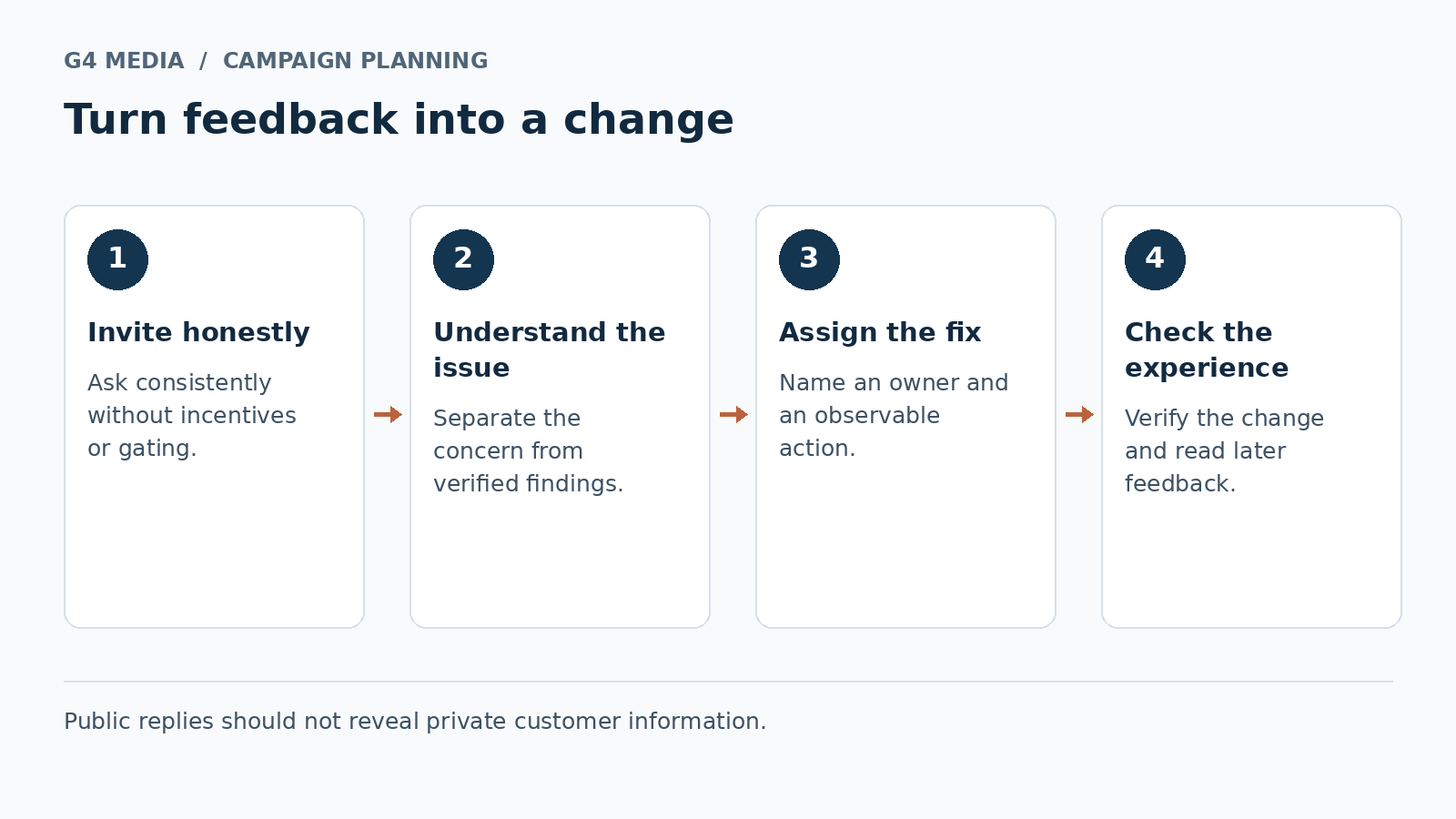
Record the customer’s stated issue, the department responsible and the process that may need attention. Keep customer details in approved systems; a shared marketing summary usually needs the theme, not a repair order or personal history.
Ask the department manager to verify what happened. Separate a customer’s report from the dealership’s findings and leave uncertainty visible where facts are incomplete. Then choose a specific action that can be checked.
For example, “Communicate better” is difficult to evaluate. “At check-in, explain whether the appointment is for drop-off or waiting, and agree on the next update” gives the manager and marketing team a concrete process to align around.
Invite honest feedback without engineering the answer
Use a consistent invitation after eligible customer interactions, subject to legitimate contact permissions. Make it easy to share an experience without selecting only customers likely to praise the dealership.
Google’s policy prohibits review incentives and selectively soliciting positive reviews. It also restricts pressure to post on the premises and requests for specific review content. Build the workflow around genuine, voluntary feedback; do not offer gifts for reviews or route dissatisfied customers away from the public-review option based on their sentiment.
The FTC’s review-rule guidance addresses fake reviews, certain incentives and suppression practices, including conduct by agencies. Have the dealership’s reviewer assess the actual workflow and current platform requirements. A larger review count is not worth an untrustworthy process.
How G4 would use the insight in a campaign
Consider an illustrative service department whose customers frequently ask when they will receive an update. Before advertising a smoother visit, the manager establishes a realistic communication process. G4 can then help shape campaign and landing-page language around the verified improvement.
The message becomes concrete: explain what happens at check-in, how the advisor provides updates and how the customer can ask a question. The claim should describe an operating practice the store can support, rather than promise that delays never occur.
The same method works with positive feedback. If customers consistently value clear explanations, examine the practice behind the compliment. A campaign can show the explanation process with permission and accurate context. That is stronger than turning an isolated compliment into a universal promise.
This is the strategic reason G4 is discussing reviews: the words customers use can reveal the proof your next advertisement needs. It does not imply that a particular reputation-management platform or review-response service is included in every G4 engagement; define those deliverables separately.
Keep the public reply focused and the investigation private
A public response should acknowledge the relevant concern and provide a dependable route to someone who can help. It should not expose customer records, vehicle identifiers, financing details or the contents of a private conversation.
Internally, give the concern an owner and a follow-up date. Resolving the actual experience matters more than winning a public argument. Keep any service resolution independent of an agreement to change or remove a review.
When using customer feedback in advertising, treat it as a separate editorial decision. Verify permission, accuracy, context and any required disclosures. A review’s public visibility alone does not settle every question about reusing it as a testimonial.
Look for evidence that the experience changed
Review counts and ratings remain useful, but add measures connected to the issue: how long concerns wait for an owner, whether promised changes were implemented and whether the same misunderstanding continues to appear.
Do not treat reviewers as a random sample of every customer. A small cluster can be a reason to investigate without establishing how common the issue is across the entire store. Compare feedback with appointment records and staff observations through appropriate access controls.
For the campaign, ask whether the message now explains the relevant process clearly. Are customers arriving with more accurate expectations? Are staff hearing fewer of the same unresolved questions? Those observations can guide the next revision even before a rating changes.
A practical monthly conversation
Bring marketing, sales and service together around a short set of themes. For each, record the customer concern, the verified operational answer, the owner of any change and the campaign content affected.
End with one action and a review date. A booking-page explanation, an advisor handoff or a more accurate offer description can be a useful first improvement. Keep a record of what changed so future feedback can be interpreted in context.
This makes reputation part of the dealership’s operating and marketing decisions. The value lies in learning from the experience customers describe and making the next promise more credible.
Frequently asked questions
Can G4 help even if we already use a review platform?
Yes, the campaign-planning discussion can use relevant feedback from an existing process. Confirm any platform administration or response work separately.
Should we ask only satisfied customers to review us?
No. Use a neutral, consistent process and follow the platform’s current rules rather than selecting recipients by likely sentiment.
Does every negative review require a campaign change?
No. Investigate the concern and look for relevant evidence or repetition. An individual report deserves attention without automatically defining the entire business.
Can a good response guarantee a better ranking?
No. Respond to help customers and address concerns. Avoid attaching a guaranteed search or sales outcome to a reply script.
What should the general manager see?
The recurring themes, unresolved issues, responsible owners and completed changes, alongside the review trends. Each should support a practical decision.
Related reading: The Dealership Marketing Scorecard a General Manager Can Use.
Let customer experience improve the next promise
Ask G4 Media to review one recurring feedback theme alongside your current campaign. Identify the operational answer first, then make that answer clear wherever the next customer encounters your dealership.
Recent Posts