

Which Mailer Earns the Appointment? G4 Media’s Playbook for Testing Dealership Creative.
The Press Box | All the news that’s fit to dance to
Illustrative AI-generated scene. Not a photograph of a G4 client or location.
Two mailers reach the conference table. One looks polished; the other feels more personal. Someone prefers the photograph, someone else likes the headline, and the final decision comes down to the strongest opinion in the room.
That is a creative discussion, but it is not yet a learning plan. The dealership needs to know which message helps an eligible customer take a useful next step—and whether the difference is large enough to change the next production decision.
G4 Media’s direct-marketing capabilities include custom mailers and trackable response paths. Our recommended testing approach connects those choices to a specific question, comparable audiences and a business outcome agreed before launch. The value is a clearer decision about what to produce next.
Begin with the customer obstacle
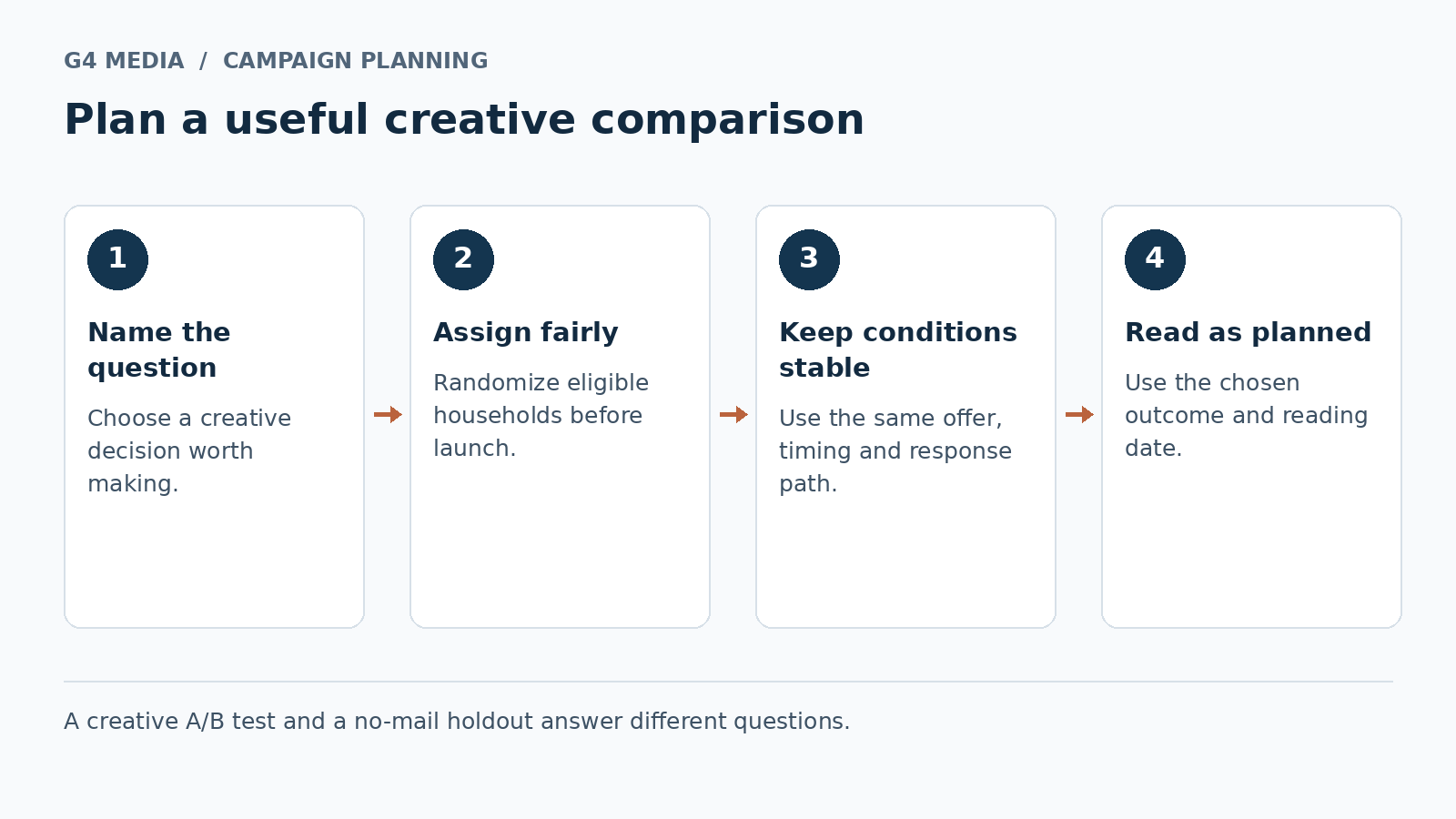
Choose a question that matters to the campaign. Are owners failing to see why an appraisal visit is useful? Are service customers uncertain about the appointment process? Does the opening line explain the benefit clearly enough?
A test should compare meaningful alternatives that answer that question. For example, a service campaign could compare a convenience-led headline with one focused on planning maintenance. Keep the underlying offer the same and make both versions accurate and readable.
Write the hypothesis in ordinary language: “For this eligible audience, explaining the available drop-off process will produce more attended appointments than the current headline.” This is an expectation to examine, not a promised result.
Define what would change your decision
Pick a primary outcome before the files go to production. A scan, a call, a booking and an attended appointment describe different stages. Choose the stage that fits the decision and can be observed reliably within the available time.
If a more expensive format is under consideration, include its additional cost. A small improvement in response may not justify the difference in production and fulfillment expense. Agree on what would count as a commercially useful improvement, then ask an analyst whether the audience and expected outcomes can support that comparison.
Also decide what happens if the evidence is inconclusive. Continuing the current format, choosing the less expensive option or running a better-informed test later can each be reasonable. A campaign should not need a declared winner to produce useful learning.
Make the comparison fair enough to interpret
Assign eligible households to versions in advance, after data checks and appropriate suppressions. Keep members of the same household together when the household is the relevant mailing unit. Avoid sending one version to loyal customers and the other to a different conquest audience, then calling the outcome a creative difference.
NIST’s guidance on randomized designs explains the underlying principle of random assignment. A dealership implementation also needs an appropriate assignment unit, sufficient sample and an analysis plan. Randomization helps create a fair comparison; it does not guarantee identical groups or a conclusive result.
Keep the offer, intended delivery timing, response experience and follow-up consistent. If one version receives an additional call campaign, the experiment is testing more than the mailer. Record any unavoidable execution differences so they can be considered in the readout.
Put G4’s creative and response work on the same brief
For the proposed test, G4 and the dealership should agree on the audience definition, the two creative versions, the response destination and the decision rule before either piece is approved. Give every version a traceable identifier in production and reporting.
Test the QR destination, phone route and mobile page. Confirm that the receiving team sees the same offer and has the same instructions for both versions. Save the approved proofs and the assignment record with the brief.
This coordination is why testing belongs with campaign planning rather than being added to the recap. The design, mailing process and response experience all influence whether the result can answer the original question. Confirm the analyst and reporting responsibilities as part of the project scope.
A hypothetical result that changes the conversation
Imagine two equally sized groups of 1,000 eligible households. Version A produces 50 scans and 10 attended appointments. Version B produces 30 scans and 12 attended appointments. These numbers are invented solely to illustrate reporting; they are not G4 results or benchmarks.
If attended appointments were the agreed outcome, A’s larger scan count would not make it the winner. B’s appointment rate is 1.2%, compared with A’s 1.0%, an observed difference of 0.2 percentage points. That small difference is not, by itself, sufficient evidence of a dependable advantage.
The team should examine uncertainty, execution and costs before choosing. It can also investigate why more scans did not become more visits. A response metric becomes useful when it helps explain the path, rather than replacing the objective after the fact.
Distinguish the creative question from the channel question
Comparing two mailed versions asks which performs better under the test conditions. Asking whether the mail campaign creates additional business requires a different comparison, such as a properly designed no-mail holdout.
Do not describe all matched sales or repair orders as incremental results. Some customers would have acted without the campaign. A holdout also needs careful planning around other contacts, measurement and the type of communication; necessary customer notices should not be withheld to create a promotional test.
Keep the claim as narrow as the design supports. A useful headline result for one audience does not establish that the same wording will outperform every alternative in every market.
Read the result on the planned date
Set the observation window and treatment of late responses in advance. Repeatedly checking and stopping when a preferred version moves ahead can create false confidence. Use an analyst-approved approach if the business needs a sequential decision process.
Keep the denominators visible: assigned households, pieces sent, known undeliverables and the chosen outcome. State which denominator the reported rate uses. Note outages, capacity changes or other problems that affected the customer’s ability to respond.
Save the conclusion with the proof files and next action. The most valuable output may be a better creative choice, but it may also be a clearer understanding of what the next test needs to resolve.
Frequently asked questions
Should we test a headline or the entire format first?
Choose the decision with the greatest practical value. A focused headline comparison is often easier to interpret; a format test may matter more if it changes production cost significantly.
Is there a minimum mailing quantity that always works?
No. Required sample depends on the expected outcome rate, meaningful difference, design and uncertainty the team is willing to accept.
Can we test more than one factor?
Yes, with a planned design and sufficient sample. Avoid treating an uncontrolled bundle of changes as evidence about one element.
What if no version clearly wins?
Report the uncertainty and make the operational choice explicitly. An inconclusive result is preferable to a confident conclusion the evidence cannot support.
What does G4 need before producing the test?
The decision, eligible audience, offer, outcome, observation window, response process and analysis owner. Those define what the creative must help the dealership learn.
Related reading: Automotive Matchback Attribution: What It Can and Cannot Prove.
Make the next production decision easier
Ask G4 Media to turn an upcoming mail campaign into a focused creative test. Agree on the question and success measure first, then put both versions into a campaign built to deliver an interpretable answer.
Recent Posts