

The Phones Rang. The Service Lane Stalled. G4 Media’s Lesson in Marketing What Your Shop Can Deliver.
The Penalty Box | Mis-Steps In Marketing
Illustrative AI-generated scene. Not a photograph of a G4 client or location.
The campaign looked successful until the customers arrived. Phones rang, booking requests increased and the service calendar filled. Then the waiting area backed up, advisors started explaining delays and a promotion designed to win business began testing customer patience.
The mistake was built into the plan: the dealership approved the offer before agreeing on the work it could fulfill. Marketing had created demand for a promise the service department interpreted differently.
This Penalty Box story is fictional. It does not describe a G4 client or report actual campaign results. G4 Media is sharing it because our service-retention work and service-oriented direct marketing need to connect demand with completed, well-served visits. The campaign’s responsibility continues after the customer responds.
The attractive offer with an unfinished operating plan
In the fictional dealership, management wants more service business during a quieter period. The creative promises a convenient maintenance visit, includes an appealing offer and directs owners to an online calendar. Everyone approves the price. Nobody asks precisely what selecting a time means.
Some guests interpret it as the time their vehicle will enter a bay. The service team treats it as a drop-off window. Some requests involve routine work; others need diagnosis, different equipment or parts that are not immediately available. The same technicians are already supporting previously booked customers.
The campaign did not fail because the link broke or leads disappeared. It failed because “appointment available” was mistaken for “the promised visit can be delivered.” The first dashboard measured the response and missed that distinction.
Convenience is part of the offer
A dealership can verify the discount and still advertise an experience it cannot support. Words such as “quick,” “same day” and “while you wait” shape the customer’s decision. So do images of loaner vehicles or a booking page that appears to promise a specific start time.
The FTC’s advertising guidance calls for substantiated claims and clear disclosures. Fine print cannot contradict the main impression. Operationally, the same principle is useful: write the invitation so the customer and service manager describe the expected visit in the same way.
Ask staff to read the actual ad and explain what happens next. Different answers reveal an unresolved promise. Correct that before production, while the change is inexpensive and no customer has rearranged their day around it.
Build a capacity brief alongside the creative brief
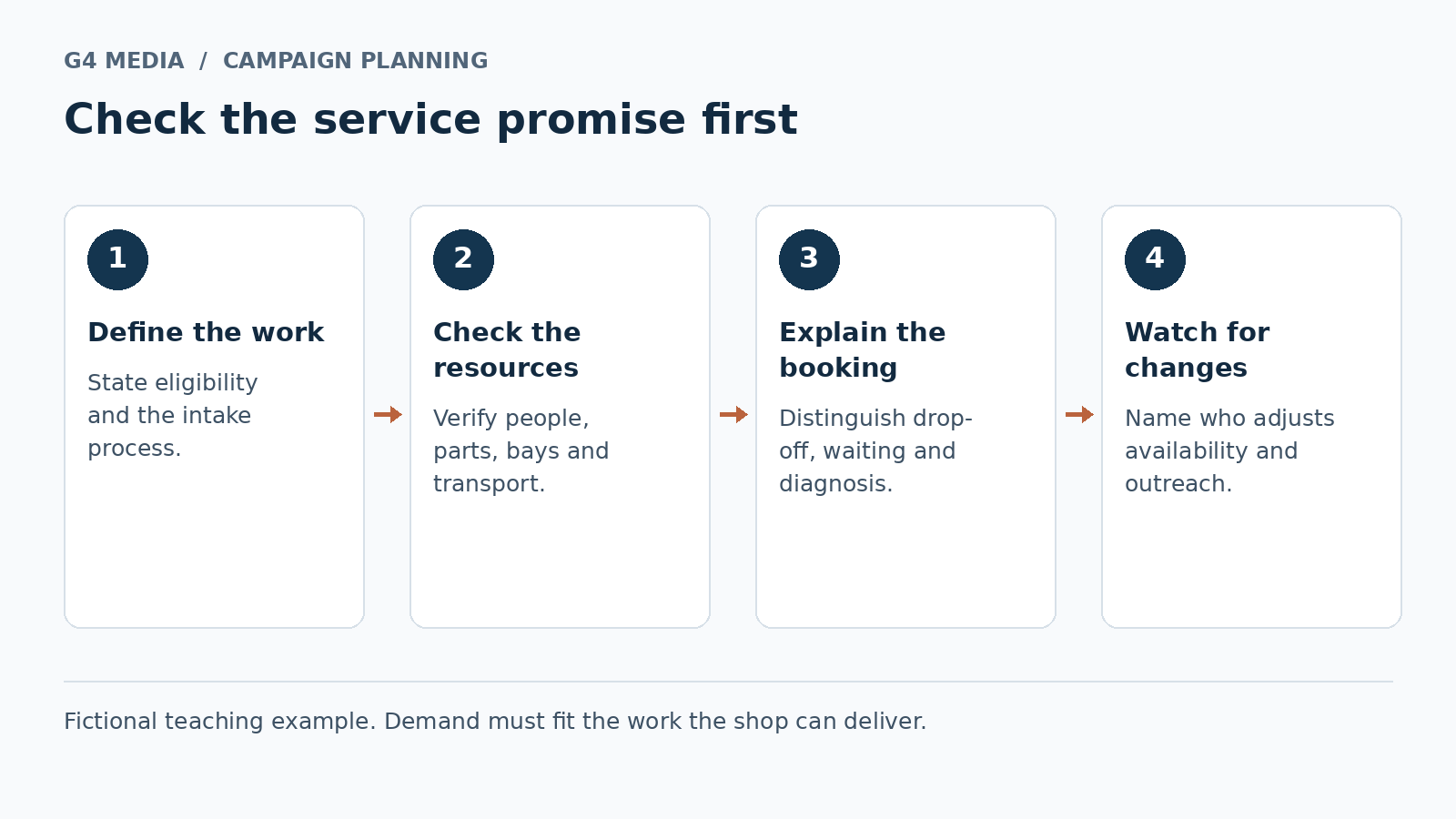
The service manager should define eligible work, supported vehicles, required resources and the meaning of each appointment type. Separate a diagnostic visit from a commitment to complete a repair. Identify any parts, equipment or transportation constraints that affect the invitation.
Then review existing demand. A campaign does not receive an empty shop simply because it has a separate budget. The plan should account for normal bookings, variability and the people responsible for updates when conditions change.
For a proposed campaign with G4, this becomes a shared approval document. The dealership verifies what it can deliver; G4 shapes audience, timing and messaging around that approved offer. Confirm any scheduling integration or capacity-triggered automation separately rather than assuming it is included.
The economics of an overfilled calendar
An appointment count can hide costs. Advisors spend time correcting expectations. Customers reschedule or leave. The shop may discount work to resolve dissatisfaction. Future availability can also be consumed by jobs that are a poor fit for the promotion’s purpose.
Review the campaign through completed visits and dealership-approved contribution measures. Distinguish revenue from gross profit and account for relevant discounts, promotional costs and fulfillment expense. Avoid treating a busy waiting room as proof of healthy economics.
This does not mean service campaigns should always be small. It means volume needs a reason. Start with the work the shop wants and can support, then choose a sensible audience and release plan using the store’s own response history where available.
What a G4 planning conversation should resolve
Before approving the mailing quantity or media budget, resolve five questions: What work is being offered? Who is eligible? What does the appointment reserve? What happens when capacity changes? Which completed outcome will define success?
G4’s role is to make those answers visible in the campaign. A narrower invitation can emphasize a supported service need and an accurate appointment process. A staged release can give the dealership an opportunity to review response before committing the next wave.
Printed pieces already in circulation cannot be recalled. Maintain the response page and prepare the call team to explain current availability without quietly replacing the original offer. Decide in advance who can pause future activity and how booked customers will be contacted if their arrangements are affected.
Recover the experience before restarting the promotion
In the fictional scenario, the immediate response should be to verify commitments already made, contact affected customers and correct the booking explanation. The store should identify which work it can serve reliably before inviting another wave.
An advisor should not be left to apologize for an undefined promise at the counter. Give the team approved terms, accurate alternatives and an escalation owner. Record the reasons visits changed so the revised campaign addresses the actual cause.
Once the operating plan is clear, resume with a manageable scope and review completed visits. This is an operational pilot, not proof that the revised creative caused incremental revenue. Its first job is to establish that the campaign can be fulfilled as described.
What belongs in the next recap
Show inquiries, accepted appointments, arrivals and completed work separately. Add appointment changes, customer complaints and the reasons the department could not accommodate requests. Review job mix and contribution using consistent definitions.
Then ask whether the campaign brought the kind of work the shop intended to attract. A high response rate from unsuitable vehicles or unsupported work points to a targeting or promise problem. A suitable audience encountering unavailable resources points to a planning problem.
That distinction helps G4 and the dealership decide what to change. The next answer may be a smaller wave, a different appointment category, revised copy or improved internal coordination. More advertising is useful only when it feeds a visit the store can deliver.
Frequently asked questions
Should a busy service department stop marketing?
Not automatically. It may promote future availability or a different supported need. The timing, volume and promise must reflect the actual operating plan.
Is an open online slot proof of available capacity?
No. Verify the appointment’s meaning and the staff, equipment and parts required for the work it accepts.
Who should sign off on the offer?
Service management should verify fulfillment, and the appropriate reviewer should check the claims and terms. Marketing then communicates the approved facts.
Can G4 automatically pause campaigns when the shop fills?
Do not assume a particular integration. Agree on available technology and a named manual fallback when scoping the campaign.
What is the simplest prelaunch test?
Have someone follow the actual invitation through booking and ask the receiving team what the customer should expect. Resolve mismatches before wider release.
Related reading: The Dealership Marketing Scorecard a General Manager Can Use.
Keep the next successful promotion out of the Penalty Box
Ask G4 Media and your service manager to review the next offer together. Approve the work, appointment meaning and response plan before the audience size—so the campaign succeeds in the service lane as well as on the dashboard.
Recent Posts