

Sales Went Up. What Actually Worked? G4 Media on the Campaign Test That Couldn’t Answer.

G4 Media Editorial Team • October 19, 2026

Share this article

The Penalty Box | Mis-Steps In Marketing

Illustrative AI-generated scene. Not a photograph of a G4 client or location.

The new campaign beats last month’s sales total. At the recap, the redesigned mailer gets the applause. Next month’s budget shifts toward the more expensive format, and the dealership begins treating its success as a proven rule.

There is one problem: the store also changed the audience, offer, digital support and timing. Inventory and staffing were different, too. The result describes a better month, but it cannot isolate what the new design contributed.

This is a fictional Penalty Box example, not a G4 engagement or measured result. G4 Media is raising the issue because coordinated campaigns contain multiple moving parts. Our direct-marketing and digital media capabilities can work together; the measurement plan must be equally deliberate about what the campaign is intended to teach.

A useful business result becomes an unsupported explanation

In the fictional dealership, the new launch includes a larger mailing audience, a different offer and added digital support. The creative has a more elaborate presentation, and the sales team has more suitable inventory available during the response window.

Sales improve. The team reasonably wants to keep the momentum. But the conversation jumps from “This campaign coincided with stronger results” to “This print format caused the improvement.” Those statements require different evidence.

The danger appears in the next decision. If the format was not the main driver, the store may increase production cost while abandoning the audience or offer that mattered more. A confident explanation can become expensive when it is repeated without a fair comparison.

Start the recovery with a change record

Before debating the favorite explanation, reconstruct what changed. List the audience definition and size, offer, creative, channel support, dates, spend, inventory conditions and response process. Keep documented facts separate from memories and guesses.

Check whether the outcome itself is comparable. Did both reports use the same sales window? Were duplicate leads handled consistently? Did one campaign count all matched transactions while the other count only tracked responses? An apparent performance difference can reflect a reporting change.

Keep gaps visible. If the original assignment file or proof cannot be recovered, say so. A less precise but honest comparison is more useful than a detailed reconstruction that invents missing history.

Ask which decision management needs to make

The question might be whether to pay for a premium print format, whether digital support adds value or whether the overall promotion generates incremental business. Each calls for a different design.

If the format is the decision, compare formats under otherwise comparable conditions. If digital support is the decision, plan the relevant campaign and comparison groups before launch. If the objective is incremental impact, account for what would likely happen without the campaign rather than crediting every matched transaction to it.

NIST’s experimental-design guidance provides different approaches for different questions. The practical lesson is to choose the question and design together, rather than look for a convenient explanation after seeing the numbers.

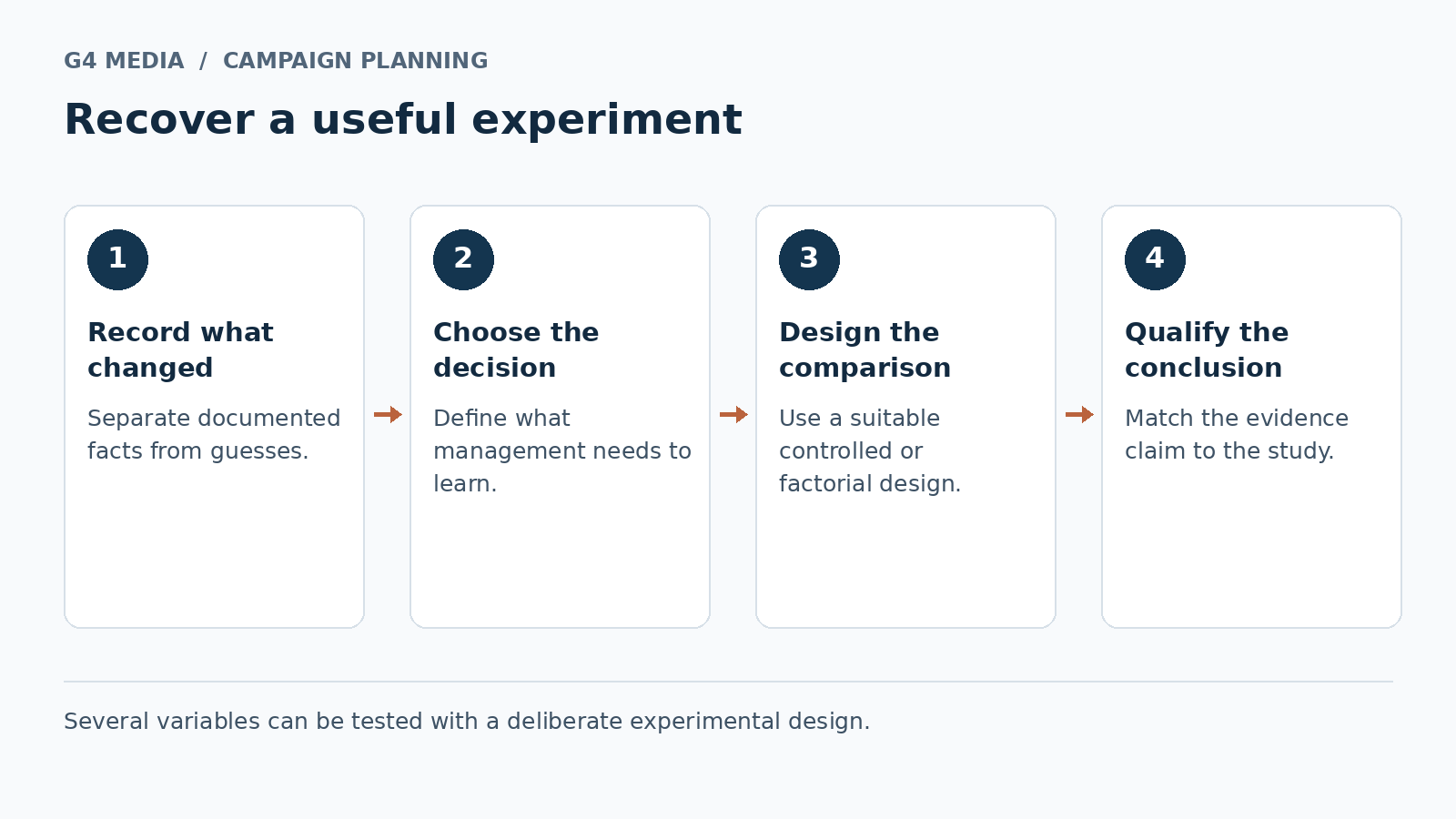
Experiment decision path from documented changes to focused question, valid comparison and qualified conclusion.
Original planning diagram. Adapt the recommendations to the dealership.

What G4 would put into the next brief

Begin with one decision statement: “We need to know whether the premium format creates enough additional completed appointments to justify its cost.” Then identify the eligible audience, comparison, primary outcome, observation window and analysis owner.

G4 and the dealership should align the production proofs, response paths and follow-up around that plan. Keep a version record so the analyst can connect each approved treatment with the appropriate recipients and outcomes. Confirm the research and reporting scope in advance.

This is a distinct job from selecting good creative. A well-written campaign can still be an uninformative experiment if its comparison is poorly designed. Bringing the measurement question into planning protects the value of the creative and media decisions the store is paying to make.

A bundle can be tested, but the conclusion belongs to the bundle

Changing several campaign elements together is not inherently wrong. A dealership may need to replace an entire underperforming program quickly. It may also deliberately compare two complete approaches using an appropriate design.

The important distinction is what the result can explain. A fair comparison between two bundles can inform a choice between those bundles. It does not automatically identify how much each headline, audience rule or channel contributed separately.

Where the business needs to understand several factors and their interactions, a planned factorial design may be appropriate. NIST notes that one-factor-at-a-time approaches can miss interactions. More complex designs require sufficient sample and analysis; dividing a small audience into many groups can leave the team with little useful evidence.

Keep last month in context

Historical results remain valuable for planning and monitoring. They can show whether the current outcome is unusual or whether a workflow problem is recurring. But a different month brings different conditions, including demand, available vehicles, pricing and staffing.

Use a before-and-after comparison with those limits stated. Avoid turning the difference into a claim of proven creative lift. If a credible concurrent comparison is possible, design it before the next campaign and document other exposures that could affect the result.

The objective is not to make every marketing decision wait for perfect evidence. It is to understand how much confidence the available evidence deserves and what uncertainty remains when money is committed.

Make a practical choice without inventing certainty

Suppose the next comparison produces similar outcomes for two formats. Management might choose the less expensive version, the easier production process or the option that fits the dealership’s brand. That can be a sensible business decision.

Record the reason accurately: the results did not establish a meaningful difference, and cost or execution favored one option. Do not rewrite that as proof that one format sells more vehicles. Future teams need to know which conclusions were measured and which were operating choices.

Also define what evidence would change the decision. A future test with a different audience or offer may reveal a different pattern. Keeping the original context prevents a provisional choice from becoming an unquestioned rule.

Turn the recap into a better next campaign

Separate three statements in the report: what happened, what the design supports and what the dealership will do next. A stronger sales total belongs in the first. A justified comparison belongs in the second. The budget or production decision belongs in the third.

This structure gives G4 and the dealership a more productive discussion. They can recognize useful business, identify execution problems and plan the next question without overstating the evidence. That is how a campaign becomes a source of learning rather than another story built around a preferred result.

Frequently asked questions

Was the campaign wasted if we cannot isolate the cause?

No. It may have generated useful business and revealed practical lessons. Report those outcomes without attributing them to one untested component.

Must every test change only one thing?

No. Focused A/B comparisons and planned multi-factor designs serve different questions. The design must support the claim being made.

Can we compare two complete campaign approaches?

Yes, with an appropriate comparison and analysis. Interpret the result as evidence about the approaches as a whole, not automatic proof about each ingredient.

What if the audience is too small for a clear answer?

Reduce the question, acknowledge uncertainty and use costs and operating constraints transparently in the decision. More test cells do not create more evidence.

How is this different from choosing the best mailer?

Creative testing compares defined alternatives. This problem begins earlier: the dealership must recover a valid decision from a campaign that changed too many things to explain the result it claims.

Know what you are learning before you launch

Ask G4 Media to review the decision behind your next campaign test. Align the creative, audience and measurement plan so the recap can explain both the result and what the dealership should do with it.

Recent Posts

Fictional service advisor reviewing an appointment schedule while an occupied workshop handles waiting vehicles.
By G4 Media Editorial Team • October 19, 2026
A fictional Penalty Box story shows why G4 Media recommends aligning service offers, audiences and appointment capacity before a campaign launches.
Illustrative dealership staff preparing an orderly appointment welcome area before an event.
By G4 Media Editorial Team • October 19, 2026
Build dealership event appointments before launch. G4 Media connects invitations, booking support and prepared staff around a useful customer visit.
Illustrative desk with two comparable automotive mailer versions prepared for a creative test.
By G4 Media Editorial Team • October 19, 2026
Plan dealership mail tests around customer questions, comparable audiences and business outcomes. G4 Media connects creative to the next decision.
Illustrative dealership team discussing customer feedback in a showroom office.
By G4 Media Editorial Team • October 19, 2026
Use dealership feedback to improve customer experience and campaign credibility. G4 Media explains how to turn review themes into useful action.
Illustrative service advisor explaining a documented vehicle finding and estimate to an owner.
By G4 Media Editorial Team • October 19, 2026
Help owners revisit declined service with clear explanations, relevant follow-up and a practical response plan shaped with G4 Media.
Illustrative vehicle-delivery handoff with a service appointment shown on a tablet.
By G4 Media Editorial Team • October 19, 2026
Connect vehicle delivery to the first service relationship with G4 Media’s retention perspective, useful reminders and accurate customer handoffs.
Illustrative San Antonio dealership scene with a pickup and crossover representing different vehicle needs.
By G4 Media Editorial Team • October 19, 2026
Connect San Antonio truck buyers’ real needs with verified inventory, relevant campaigns and prepared dealership appointments through G4 Media.
Illustrative Orlando dealership reception welcoming a driver establishing a local service relationship.
By G4 Media Editorial Team • October 19, 2026
Win Orlando newcomers’ first service visit with a clear welcome campaign, prepared advisors and a plan for the relationship that follows.
Illustrative dealership exterior in Edison, New Jersey, with a welcoming customer entrance.
By G4 Media Editorial Team • October 19, 2026
G4 Media helps Edison dealerships answer buyer questions through clearer campaigns, useful content and a prepared path to the showroom.

Show More