Choose a Defensible Window
The attribution window should reflect the decision, channel, and offer. A service appointment may occur quickly. A vehicle purchase may take longer. An excessively short window misses influence; an excessively long window collects unrelated outcomes.
Set the window before reading the results. Report transactions that occurred before exposure separately or exclude them. Google Ads similarly notes that an offline conversion cannot occur before the associated ad click. That rule is technically specific to its import process, but the underlying logic is universal: the outcome must follow the claimed exposure.
Move From Matches to Incrementality
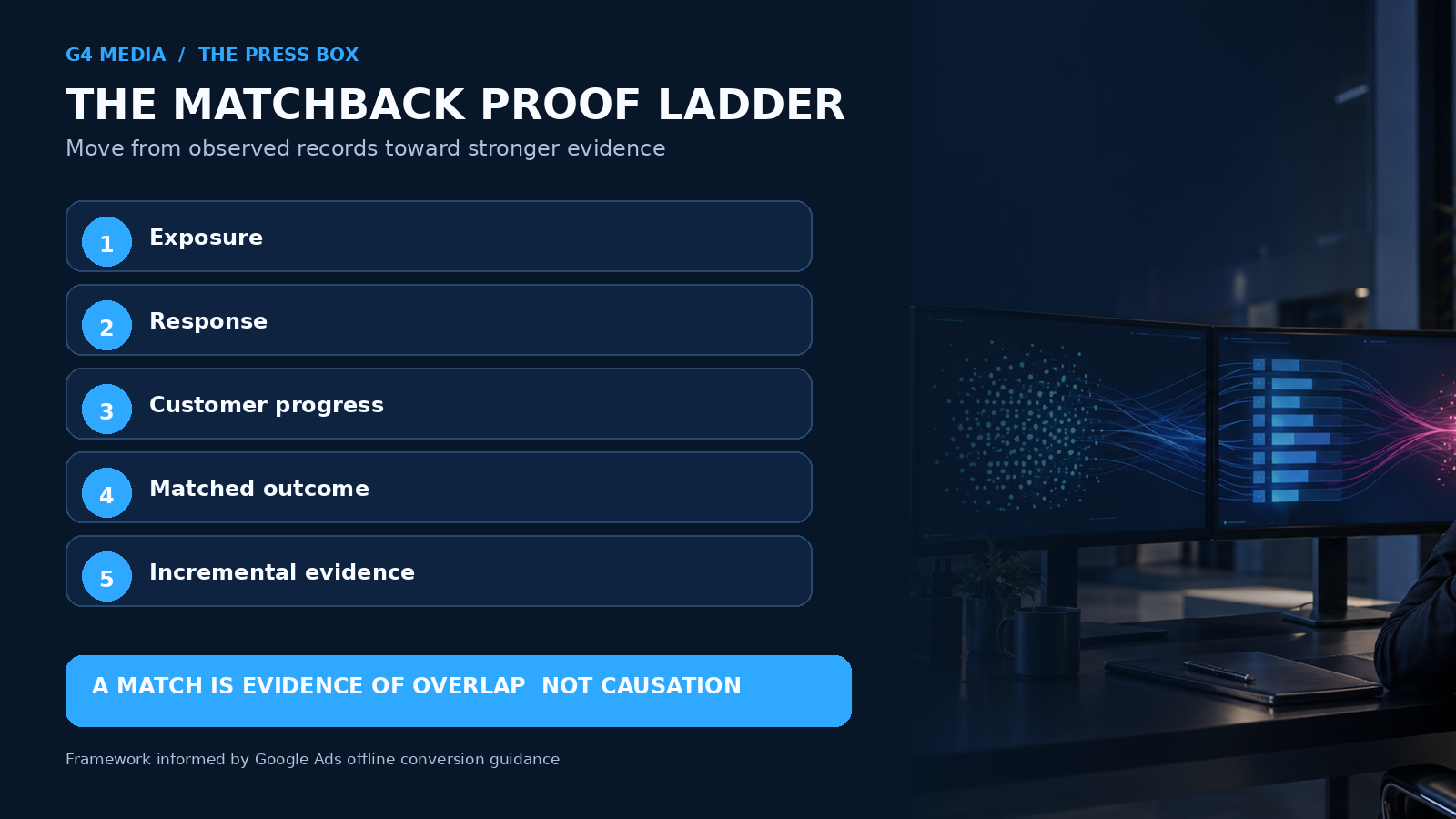
The strongest practical ladder has five levels.
-
Delivery or exposure:
The campaign reached the planned audience under the channel's definition.
-
Response:
The person scanned, clicked, called, replied, or submitted a form.
-
Progression:
The response became a qualified lead, appointment, or show.
-
Matched outcome:
The exposure or response matched a sale, repair order, or acquisition.
-
Incremental evidence:
A holdout, staggered launch, historical baseline, or other credible comparison suggests the campaign changed the outcome.
Not every campaign can support a perfect experiment. The answer is not to hide the limitation. State the design used, show the denominator, and avoid translating a match rate directly into return on ad spend unless revenue, gross, costs, and attribution assumptions are also supportable.
USPS Informed Delivery campaigns can add digital interaction metrics to eligible mail, and Google Ads supports connecting offline outcomes to earlier clicks or calls. These tools improve observation, but they do not eliminate overlap between channels or the need for dealership definitions.
G4 can help build a measurement plan that begins with the audience and follows through response, CRM status, and dealership outcome. G4 lead conversion and identity resolution
can support the connection, while the reporting method should preserve uncertainty instead of inflating certainty.
Ask G4 Media
to review the exposure file, outcome definitions, match window, and comparison design before the next campaign launches.
Risks and Limits
-
A matched transaction may have happened without the campaign.
-
Household matches can include another driver or buyer.
-
Missing or stale contact data can lower match coverage unevenly.
-
Platform, mail, CRM, DMS, and vendor definitions may not align.
-
Gross and revenue fields require accounting agreement and permission.
-
Small samples and multiple campaign exposures can make comparisons unstable.
Frequently Asked Questions
What is automotive matchback
It is a process that compares a campaign exposure or response file with later dealership outcomes using approved identity fields and rules.
Is match rate the same as conversion rate
No. Match rate describes records connected under the chosen logic. Conversion rate requires a defined denominator and event. Neither automatically proves incremental lift.
How long should the attribution window be
Choose it before launch based on the offer, buying cycle, and historical timing. Report sensitivity to a different window when the conclusion could change.
Do QR scans prove a sale came from mail
A scan is strong response evidence for that piece or destination. A later sale still needs a documented connection and may have other influences.
What should a dealer request from a vendor
Ask for the exposure definition, match fields, hierarchy, window, exclusions, denominators, unmatched counts, duplicate handling, outcome source, and whether any control group was used.
Sources