

San Antonio Truck Buyers Have a Job to Do. G4 Media Helps Your Dealership Win the Right Conversation.
The Press Box | All the news that’s fit to dance to
Illustrative AI-generated scene. Not a photograph of a G4 client or location.
A truck shopper clicks an ad, visits the dealership and discovers that the advertised vehicle does not fit the job. The engine may be right but the configuration is wrong. The price may appeal while the cab, cargo space or equipment does not. Marketing produced a lead; the customer still lacks a useful answer.
For San Antonio dealerships, the opportunity is to make the intended use part of the campaign from the beginning. A person comparing vehicles for work has a different decision to make from someone considering a family vehicle with occasional towing needs. Both deserve more than a truck photo and a monthly-payment headline.
G4 Media’s recommended approach connects the customer’s task to the message, available inventory and a prepared sales conversation. Our digital media and lead-conversion capabilities provide a foundation for that journey. The strategy is to make the appointment more relevant before the shopper arrives.
The wrong lead may be a poorly framed invitation
If every ad promotes “truck deals,” responses can conceal very different needs. One customer is replacing a daily driver. Another needs to carry equipment. Another wants advice about a trailer. Sending all three through the same generic conversation makes it harder to distinguish a weak lead from a weak match.
Begin by reviewing recent inquiries and the reasons they stalled. Was suitable inventory unavailable? Did the customer need a capability the salesperson could not verify? Did the form collect a phone number but lose the task that motivated the inquiry?
Those answers tell G4 what the campaign needs to communicate and what the store must prepare. They also identify where additional spending would create more of the same mismatch.
Organize around use, then choose the audience
A proposed San Antonio campaign can start with three distinct conversations: carrying people and everyday cargo, towing or hauling for a specified task, and replacing a business vehicle. These are customer needs, not assumptions based on appearance, occupation or a Texas address.
Choose the conversation your inventory and team can support best. If the store has suitable vehicles and someone equipped to discuss work requirements, build the invitation around a prepared comparison. If its strength is household versatility, show how shoppers can compare seating, storage and everyday usability.
Local relevance should also include the trip. Ask where customers are coming from, whether timing is a barrier and what would make a visit worthwhile. Use the dealership’s real customer patterns rather than treating all of San Antonio as one uniform market.
Replace a maximum-capability claim with a useful next step
Vehicle specifications matter, but the largest number in a model advertisement may not describe the specific truck on the lot. Ford’s towing resources distinguish payload from towing capacity and provide vehicle-specific guides. Configuration and equipment need to be checked against the actual vehicle and intended use.
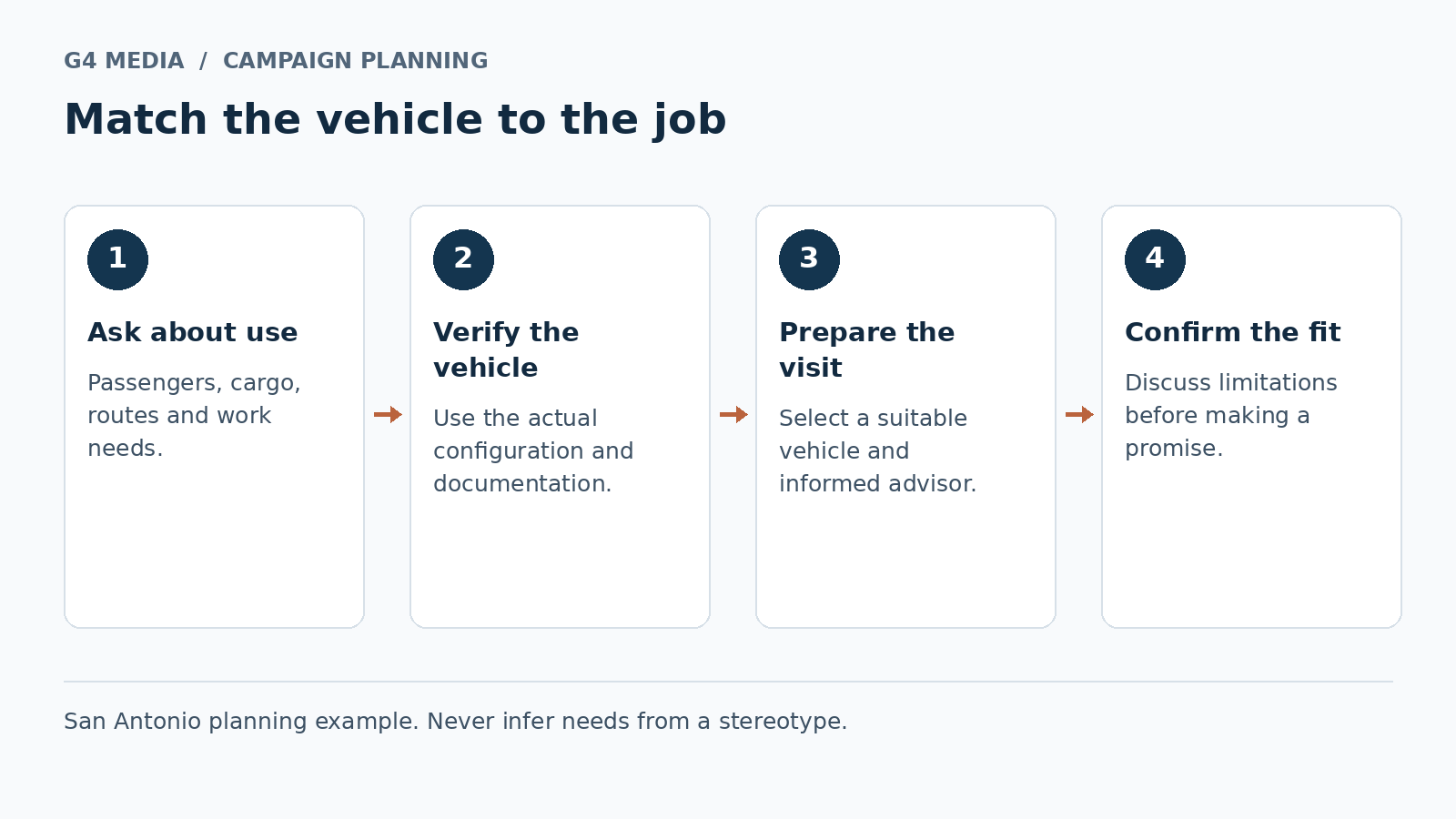
The campaign’s job is to invite that verification. A practical message could be, “Tell us what you need your next truck to handle. Request a comparison of available configurations.” The dealership must then assign someone who can review the relevant information and explain any limitations.
Avoid a form that pretends to calculate suitability from two quick answers. Capture enough to prepare a conversation, then use the manufacturer’s current documentation and qualified staff. An image of a truck pulling a trailer is not evidence that every advertised vehicle can handle a customer’s setup.
How G4 would build the campaign
Start with a narrow inventory group and a defined customer task. Write the creative around the decision: compare cab and cargo options, explore a suitable replacement, or discuss a towing requirement. The landing page should continue that same conversation and identify the available next step.
Ask only the questions necessary for the handoff. “What do you need the vehicle to do?” and “Is there a particular vehicle you want to compare?” can be more useful initially than a long form full of information the customer is not ready to share.
G4’s contribution is to connect targeting and creative with the response experience. The store remains responsible for vehicle suitability and current availability. The campaign scope should specify how inventory changes are reflected, where requests are routed and which person prepares the comparison.
A better conversation before the test drive
Consider an illustrative shopper who likes a truck’s advertised price but needs both passenger room and space for work equipment. A general appointment request reaches the showroom with little context. Staff begin with available units and discover the requirements later.
Under the proposed approach, the customer states the use before booking. The team reviews possible matches, identifies any unanswered specification questions and explains what can be compared at the visit. If the store lacks a suitable option, it can say so promptly and discuss an appropriate next step.
The value is preparation. The shopper has a reason to attend, and the team has a reason for selecting the vehicles it presents. This is a suggested workflow, not a claim about measured campaign results.
Keep the ownership opportunity in view
A useful truck conversation can also reveal service questions: supported vehicle sizes, appointment arrangements, particular equipment or scheduling needs. Route those to fixed operations rather than treating every response as a sales lead.
For an owner whose vehicle supports their business, time away from the vehicle may be a central concern. Explain the actual intake and update process. Advertise transportation or commercial-vehicle capabilities only when the department can provide them under stated conditions.
This is an appropriate connection to G4’s fixed-operations and service-retention work. Sales and service can share an understanding of the customer’s needs while maintaining separate campaigns, responsibilities and measures.
Report the quality of the match
Separate general inquiries, qualified comparisons, confirmed appointments and attended visits. Record the reason an inquiry cannot progress: configuration unavailable, request outside capability, timing conflict or insufficient information.
Review the mix with sales management. If many people ask for equipment the store does not carry, the campaign may need narrower messaging. If suitable shoppers fail to attend, examine confirmation and preparation. If the right people arrive but the vehicles are unready, the obstacle is in fulfillment.
The useful performance question is whether the campaign helps the store create more relevant opportunities at an acceptable cost. A low cost per form submission alone cannot answer that.
Frequently asked questions
Should every San Antonio campaign emphasize trucks?
No. Start with the dealership’s actual inventory, capabilities and customer demand. Geography is context, not proof of an individual preference.
What is the best first question for a truck shopper?
Ask what the next vehicle needs to do. Then clarify the requirements that affect the comparison with a knowledgeable team member.
Who verifies towing or payload suitability?
The dealership’s qualified staff should use current manufacturer information and the specific vehicle configuration. Advertising should invite that assessment without substituting for it.
Can one page serve sales and service inquiries?
It can offer clear routing, but each path needs a relevant next step and a responsible team. Keep outcomes separate in reporting.
What would G4 need to start?
An inventory group, the customer task it serves, a prepared response owner and examples of recent inquiries that did or did not fit.
Related reading: Inventory Advertising Without Channel Silos.
Turn capability into a reason to choose your store
Ask G4 Media to build a San Antonio campaign around the work your customers need their vehicles to do. Connect the promise to verified inventory and a prepared comparison, so the first conversation earns the next one.
Recent Posts