The Geography Trap When a Bigger Audience Makes a Worse Campaign
The Geography Trap: When a Bigger Audience Makes a Worse Campaign
The Penalty Box Mis-Steps in Marketing| September 2026 | Draft for Review
More reach can hide less customer progress.
The Short Answer
A bigger geographic audience can make a dealership campaign look cheaper while making the business result worse. The campaign collects more impressions and leads, but too many people face an inconvenient drive, weak inventory fit, a stronger nearby competitor, or an offer that does not justify switching stores. The BDC spends time on unlikely appointments, show rate falls, and cost per sale rises even while cost per lead improves.
The remedy is not a universally smaller radius. It is an evidence-based trade area divided into core, growth, and test zones. Use customer origin, drive time, competitive density, inventory advantage, service capacity, and actual downstream outcomes. Then set channel location options and direct-mail files to follow that map. This Penalty Box example is a composite with no named dealership. Its lesson is simple: reach is valuable only when the store can credibly convert and serve the people being reached.

The Misstep
A dealership wanted more leads. The existing campaign covered the store's dependable trade area, but weekly volume had flattened. Instead of diagnosing the constraint, the team expanded every campaign outward and loosened platform location settings.
Top-line activity rose. Impressions increased. Lead cost declined. The early report looked like a win.
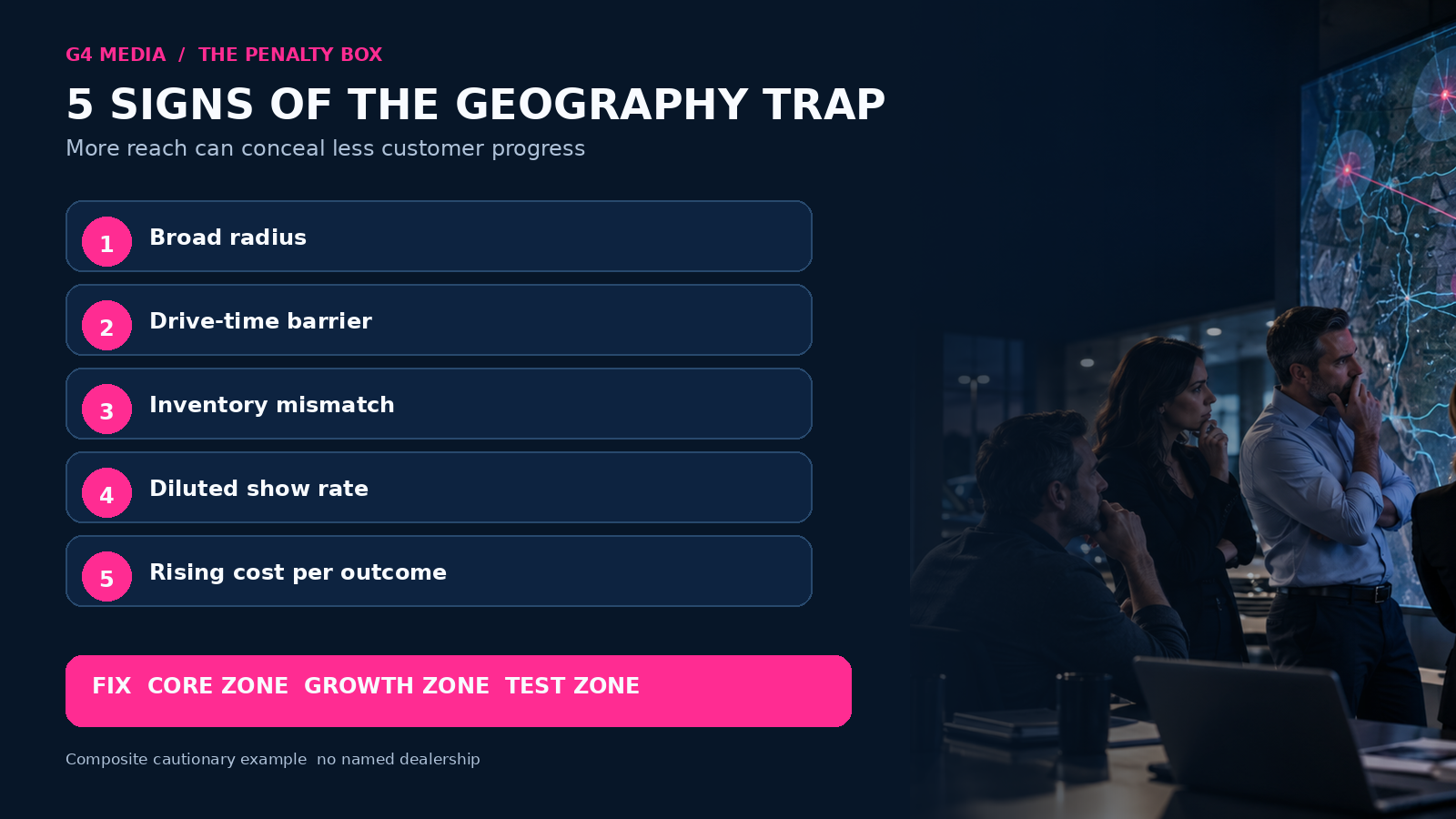
The operational picture was different. Some respondents lived well beyond a practical drive at shopping hours. Others had a nearby franchise point with comparable inventory. Several asked about vehicles the store could not reasonably differentiate. Appointment setters worked more records, but show rate fell. Sales staff began describing the leads as low quality. Management responded by asking for even more volume.
The campaign had optimized the easiest metric to grow, not the hardest outcome to earn.
Why the Dashboard Hid the Problem
Geographic expansion changes the audience mix. A blended campaign average can hide the difference between a nearby ZIP that produces repeat buyers and a distant area that produces inexpensive form fills but few shows.
The team also treated platform geography as an exact residential boundary. Google Ads explains that location targeting can consider physical presence and, depending on settings, interest in a location[cite: 1]. That can be useful for some goals, but it needs explicit review. A person interested in a city is not necessarily someone who lives within the dealership's practical market.
Direct mail can introduce a different error when the list is selected by a clean circle or broad county without accounting for drive time, roads, water, density, competing rooftops, owner profile, or inventory fit. Matching the digital radius to the mail geography does not fix the strategy if the geography itself is wrong.
Diagnose the Real Constraint
Before changing the map, determine what management is actually trying to improve.
-
If the store needs more qualified demand, review audience and message.
-
If appointments are weak, review response speed, scripts, offer, and routing.
-
If shows are weak, review convenience, confirmation, distance, inventory availability, and customer expectations.
-
If close rate is weak, review inventory, price, desk process, and lead qualification.
-
If service capacity is full, adding response can create a worse customer experience.
Geography may be one cause, but it is not a substitute diagnosis for the rest of the funnel.
Rebuild the Market in Three Zones
Start with verified sold and service customers, then remove duplicates, bad addresses, wholesale transactions, employee deals, and other records that should not define the market. Add realistic drive time, brand and vehicle demand, competitive pressure, inventory advantage, and store capacity.
| Zone | Purpose | Message | Measurement rule |
|---|---|---|---|
| Core | Protect proven demand | Convenience, familiarity, relevant inventory | Maintain profitable progression and retention |
| Growth | Win credible new share | Specific reason to switch | Compare qualified outcomes with core context |
| Test | Learn under uncertainty | One focused proposition | Fixed budget, duration, sample, and stop rule |
For a fast-changing market such as Raleigh and Wake County, update the map as population, roads, inventory, and customer patterns move. The Census Bureau estimated Wake County's 2025 population at 1,257,235, 11.3 percent above its April 2020 estimate base. Growth supports re-examination; it does not prove that every new household belongs in the same campaign.
G4 Media direct marketing can use approved customer and conquest data, verified addresses, and response mechanisms within these zones. G4 digital media can apply and test the corresponding paid-media geography. Both should report by zone rather than only as one blended total.
Put Show Rate Back in the Room
Lead cost should be reported with appointments, shows, sales or repair orders, cost per outcome, response time, and capacity. Review counts and rates by zone. A small test cell can swing sharply, so use adequate duration and do not celebrate or abandon a market on a handful of observations.
Compare the promise with the distance. A common vehicle at an ordinary price gives a distant shopper little reason to travel. A scarce configuration, credible acquisition offer, service convenience, or unique capability can support a wider market. The reason to travel belongs in the message, not only in management's assumptions.
The G4 Media View
The Penalty Box lesson is not that broad reach is bad. Broad reach without a market hypothesis is bad. G4 can help a dealership connect the trade-area map, audience, direct and digital settings, response path, and downstream reconciliation so growth zones are tests rather than guesses.
Before moving the radius slider again, talk with G4 Media about a trade-area review tied to show and sale outcomes.
Risks and Limits
-
This is a composite cautionary example and does not describe a named dealership or reported G4 client result.
-
Historical customer concentration may reflect existing loyalty rather than open conquest opportunity.
-
Platform location signals, mailing addresses, and physical presence are not identical.
-
Population growth does not prove demand for a specific brand, vehicle, service, or offer.
-
Privacy, list sourcing, franchise territory, state law, OEM, and platform rules may constrain execution.
-
Small geographic cells need enough observations and time for responsible comparison.
Frequently Asked Questions
Is a larger dealership radius always less efficient
No. A store with distinctive inventory or a strong reason to travel may convert a wide market. The radius should follow evidence and economics.
Why can cost per lead improve while cost per sale worsens
The expanded audience may produce inexpensive responses that do not become appointments, shows, or sales. Funnel mix matters.
Should mail and digital use identical boundaries
They should follow the same zone strategy, but channel mechanics differ. Document the exact inclusion, exclusion, presence, interest, and suppression rules.
What is a useful experimental zone
It is a geography with a credible hypothesis, dedicated creative or offer, fixed budget, defined duration, measurable outcome, and stop rule.
Which metric reveals the geography trap fastest
Show rate by zone is often revealing, but it should be interpreted with lead quality, response time, inventory fit, sales, cost, and sample size.
Sources
-
Google Ads location targeting guidance Official explanation of physical location and location of interest signals[cite: 1].
-
U.S. Census Bureau QuickFacts for Wake County Official 2025 estimate and change from the 2020 estimate base.
-
Google Ads offline conversion import guidance Official guidance for connecting digital interactions with later offline outcomes.
Recent Posts