Make the Value Exchange Credible
Owners need to know what they are being offered: an appraisal, a purchase opportunity, a trade evaluation, or a specific event. Avoid language that presents a modeled value as a guaranteed offer before the vehicle is inspected and eligibility is confirmed.
The mailer, email, landing page, phone script, and appraisal desk should agree on the basics:
-
whether a purchase without a trade is available;
-
what the owner should bring;
-
whether an appointment is recommended;
-
how long the process usually takes;
-
what factors affect the final offer;
-
when any incentive expires; and
-
which exclusions or conditions matter.
A personalized URL, QR code, or text response can reduce friction, but the destination must repeat the same promise. G4's response options include PURLs, QR codes, landing pages, text response, and remote BDC support. The technology should make the next step simpler, not change the terms.
Route the Response to the Right Team
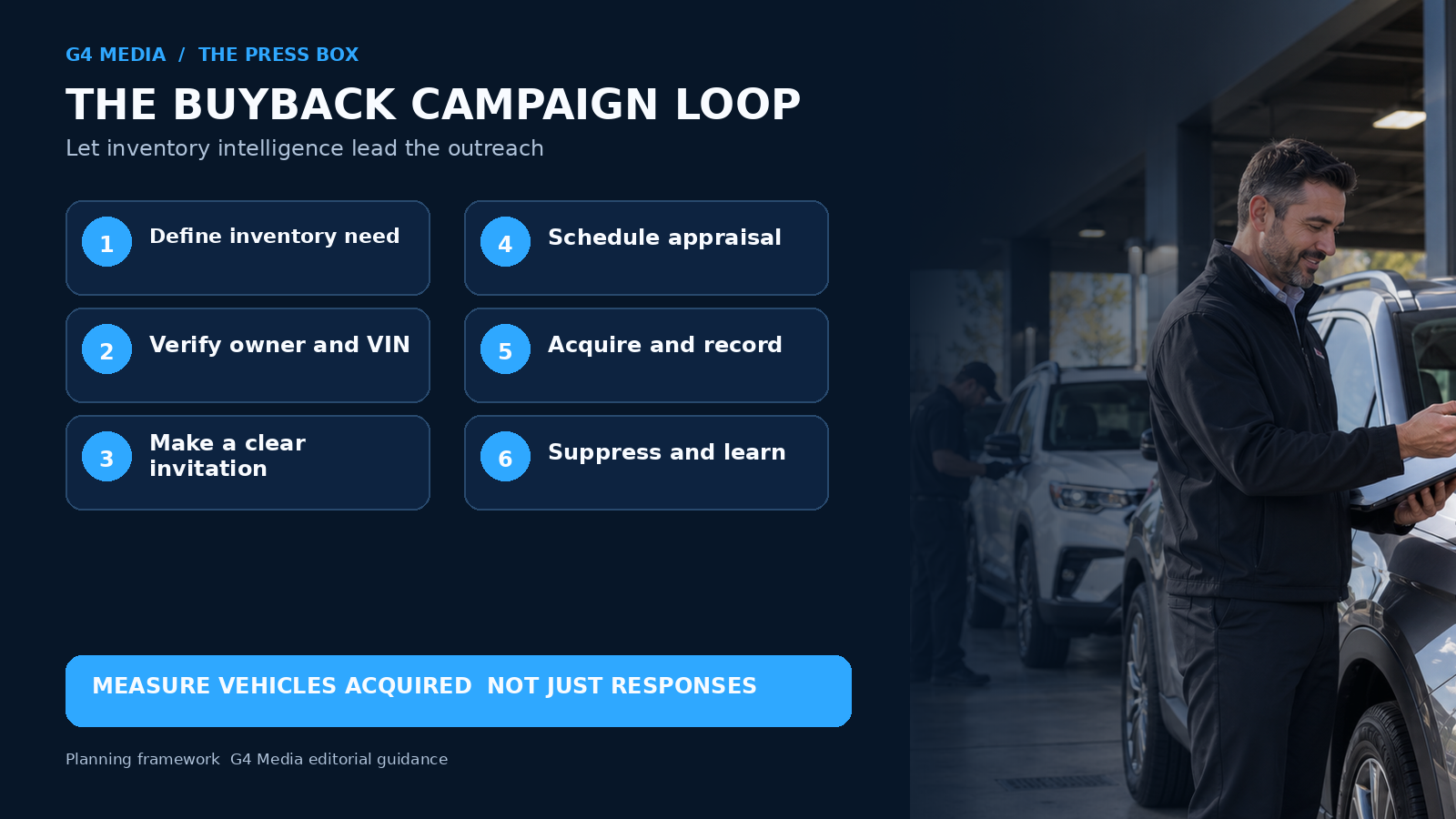
A buyback lead is not an ordinary retail lead. The first task is to confirm the vehicle and schedule an appraisal with the right person. Assign ownership before launch, create a dedicated CRM source, define contact attempts, and give the BDC an escalation path for high-priority inventory.
Measure more than form fills. Track delivered pieces, responses, verified vehicles, appointments, shows, appraisals, offers made, vehicles acquired, acquisition cost, days to frontline, retail disposition, and suppressions. When the dealership can connect marketing touches to offline events, G4 lead conversion and identity resolution
and approved CRM integrations can help close the reporting loop.
Buyback works when inventory intelligence leads and marketing follows. G4 can help translate the acquisition brief into a verified audience, a direct-mail format, coordinated digital reinforcement, a response path, and a reporting plan. The campaign should be judged by usable vehicles acquired, not by the loudness of the headline.
Ask G4 Media
for a buyback campaign review built around the units your store can actually retail.
Risks and Limits
-
A decoded VIN does not prove ownership, condition, mileage, title status, or appraisal value.
-
Modeled values and market estimates can change and should not be presented as guaranteed offers.
-
Customer and conquest data require documented permissions, vendor controls, suppression handling, and security.
-
Acquisition volume can overwhelm appraisal or reconditioning capacity.
-
A vehicle that looks desirable on paper may not be profitable after inspection.
-
State requirements, franchise rules, and offer language should receive legal and compliance review.
Frequently Asked Questions
What is a dealership buyback campaign
It is targeted outreach inviting owners to sell or trade vehicles that fit a dealership's acquisition needs. The best campaigns connect marketing criteria to appraisal and merchandising operations.
Can a dealership buy a vehicle without selling another one
Many dealers do, but the campaign must reflect the store's actual policy. State that option only when the dealership will honor it.
Should a buyback campaign use the customer database or conquest data
Both can work. Customer data offers relationship context; conquest data can fill gaps. The choice depends on inventory need, permissions, data quality, and the reason an owner should respond.
What should the campaign measure
Track appraisals, offers, vehicles acquired, acquisition cost, reconditioning readiness, and retail outcome in addition to responses.
How often should suppression files be refreshed
Refresh them as close to deployment as practical and again before follow-up waves. Sold vehicles, recent buyers, opt-outs, and open deals can change quickly.
Sources