

The QR Code Worked but the Landing Page Failed
The QR Code Worked but the Landing Page Failed
The Penalty Box Mis-Steps in Marketing| September 2026
The scan can succeed while the customer experience fails.
The Short Answer
A QR code campaign fails when the scan is treated as the finish line. The code can work perfectly while the customer reaches a slow page, sees a different offer, cannot find the promised vehicle, confronts a long form, loses confidence in the URL, or submits information that nobody routes quickly. The scan count rises, but qualified response and appointments do not.
Prevent the failure by testing the full chain on real phones and networks: printed code, secure branded destination, mobile load, message match, inventory or offer availability, short form or call path, CRM routing, confirmation, and final outcome reporting. This Penalty Box article is a composite cautionary example and names no company. The practical rule applies to direct mail, posters, service-lane materials, events, and any other offline-to-online campaign: the QR code is a doorway, not the customer experience.

The Misstep
A local campaign was built around a sharp-looking mailer and a prominent QR code. The code was tested from a designer's screen and scanned successfully. The team approved the piece, mailed it, and waited for the dashboard.
Scans arrived. Leads did not.
On a current phone over office Wi-Fi, the destination seemed acceptable. On an older phone over a cellular connection, the page loaded slowly. A large image pushed the promised offer below the first screen. The headline on the page did not exactly match the mailer. The form asked for more information than the customer expected. Inventory status was unclear. After submission, the confirmation message gave no useful next step and the record entered a generic queue.
Every component had an owner. Nobody owned the whole journey.
A Scan Is Only an Intermediate Event
QR scans help diagnose attention and access. They do not prove that the customer understood the offer, completed the form, received a response, visited the store, or purchased.
A campaign report should separate:
-
pieces delivered or materials displayed;
-
unique scans and repeat scans;
-
landing sessions and load failures;
-
qualified forms, calls, texts, or appointment requests;
-
routed and answered responses;
-
appointments, shows, sales, or repair orders;
-
opt-outs, complaints, invalid records, and unattributed outcomes.
The first two stages can improve while every later stage deteriorates. That is why the journey needs event definitions and a test record before launch.
Test the Printed Doorway
Use a sufficiently large code, clear contrast, adequate quiet space, and a placement that remains flat and unobstructed. Test a physical production proof, not only a PDF. Scan from different distances, angles, camera apps, phone generations, and lighting conditions.
The visible call to action should tell the customer what will happen: view the eligible inventory, estimate a trade, claim an appointment, or read the offer. Use a branded, secure HTTPS destination. Avoid a mysterious shortened address when the customer has no way to judge where it leads.
Build a controlled fallback such as a short readable URL or phone number. The fallback is not clutter when it protects response from a damaged code, accessibility need, or cautious customer.
Make the Landing Page Keep the Promise
The page headline, vehicle, service, dates, price or incentive, eligibility, and visual identity should match the source material. If the code is dynamic, the redirect still needs monitoring and change control.
Google describes Core Web Vitals as real-world measures of loading performance, responsiveness, and visual stability. Its current guidance recommends good performance for user experience and Search, but a campaign team should treat those metrics as a starting point. Test the actual page, device mix, form, call button, text link, inventory feed, and analytics events.
Keep the first screen focused. Repeat the promise, show the primary action, and place necessary context and disclosures where the customer can read them. Remove navigation or form fields that do not help the requested next step.
G4 Media direct marketing supports response tools such as PURLs, QR codes, landing pages, text, and BDC integration. G4 Media lead conversion and identity resolution can help connect response with later customer outcomes. The operational value comes from designing and testing those pieces together.
Prove the Handoff Before Launch
Submit a real test record from the production page. Confirm that the source, campaign, offer, customer information, consent fields, and timestamp enter the intended system. Verify assignment, notification, response template, business-hours behavior, duplicate handling, and escalation when no one acts.
The confirmation page should say what happens next and when. If the advertised vehicle or appointment disappears, provide an honest alternative path rather than silently substituting another offer.
Run the test again after any creative, redirect, form, CRM, inventory-feed, or vendor change. A previously successful code can still lead to a newly broken experience.
Use a Launch Gate
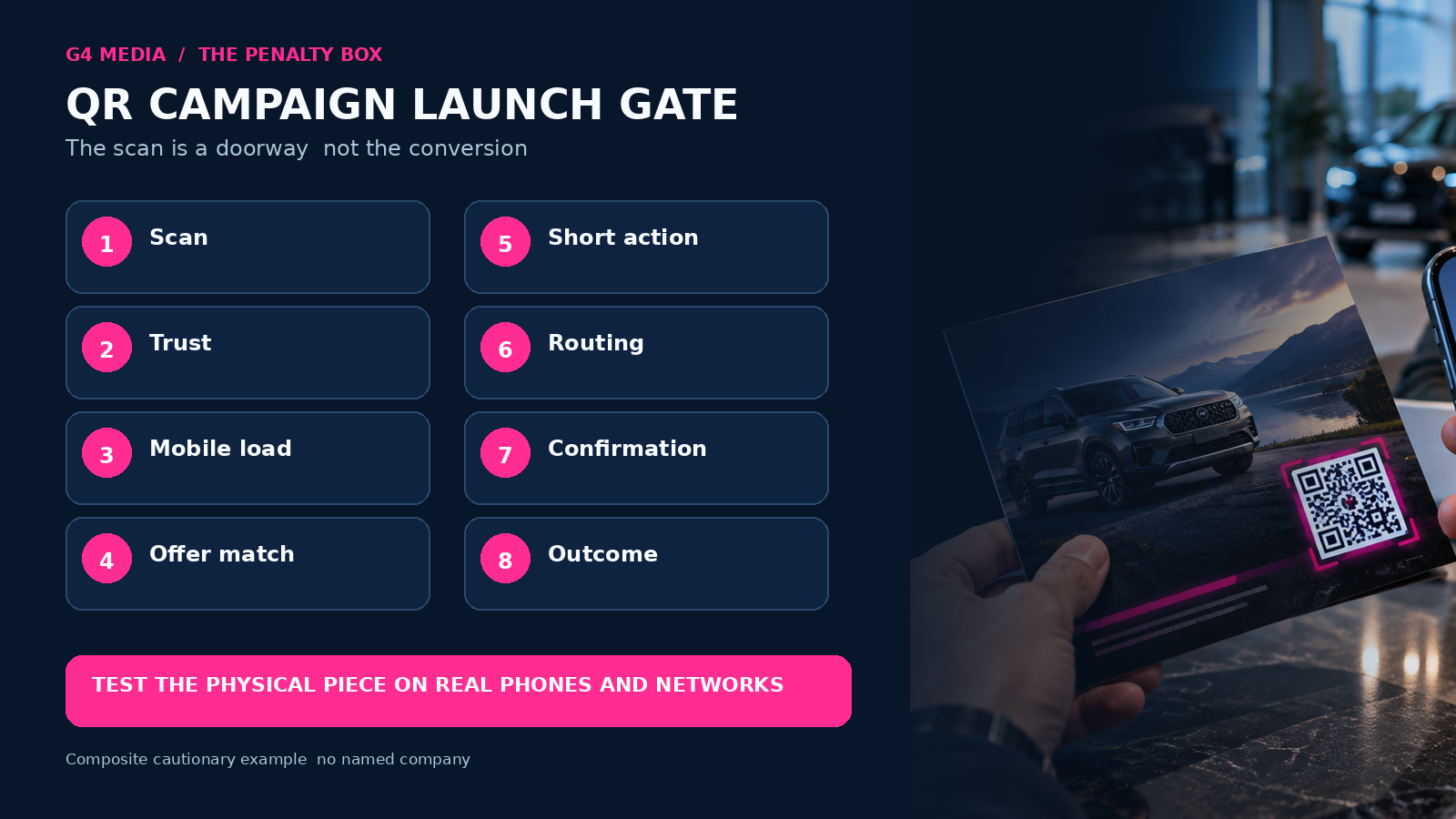
| Stage | Pass condition | Evidence |
|---|---|---|
| Scan | Physical proof scans reliably | Device and lighting test log |
| Trust | Branded HTTPS destination and clear purpose | Approved URL and source preview |
| Page | Fast, readable, and message-matched on mobile | Device test and performance report |
| Action | Form, call, or text path works | Production test submission |
| Route | Correct team receives complete context | CRM record and notification |
| Confirm | Customer gets a useful next step | Screenshot or recorded response |
| Measure | Outcome can be reconciled | Event map and reporting owner |
Any failed gate should stop the launch or remove the affected response option. A deadline is not a quality standard.
The G4 Media View
The Penalty Box lesson is a familiar one: a campaign is only as strong as its weakest transition. G4 can help coordinate creative, QR or PURL access, mobile response, routing, direct and digital support, and downstream measurement so the customer does not fall between vendors or systems.
Before the next piece goes to print, talk with G4 Media about a full response-path test from scan to store outcome.
Risks and Limits
-
This is a composite cautionary example and does not describe a named company or verified G4 client result.
-
Core Web Vitals do not measure every aspect of clarity, accessibility, trust, or conversion.
-
QR analytics may count repeat scans, bots, previews, or events that do not equal people.
-
Dynamic redirects and third-party shorteners introduce continuity, security, and governance dependencies.
-
Forms and customer data require appropriate notice, consent, access control, retention, and suppression.
-
Advertising offers and disclosures require applicable legal, OEM, lender, and state review.
Frequently Asked Questions
Does a successful scan mean the QR campaign worked
No. It only confirms access to the destination. Evaluate qualified actions, routing, appointments, shows, outcomes, complaints, and data quality.
Should a QR code go to the dealership homepage
Usually not. Send the customer to a focused, campaign-matched destination unless the homepage genuinely provides the promised next step.
How should a dealership test a QR code
Test a physical proof across devices, cameras, distances, lighting, and mobile networks, then submit the complete production response path.
What should appear above the fold
Repeat the promise, identify the relevant inventory or service, show the primary action, and preserve material context and disclosure visibility.
What is the best fallback
Use a short branded URL or staffed phone number that reaches the same approved offer and can be measured consistently.
Sources
-
Google Search guidance on Core Web Vitals Official real-world loading, responsiveness, and visual-stability guidance.
-
Google Search guidance on page experience Official mobile, secure, usable, and non-intrusive page considerations.
-
Federal Trade Commission automobile industry resources Current federal automotive advertising and consumer-protection resources.
Recent Posts