


Multilingual Dealership Marketing Beyond Translation
Multilingual Dealership Marketing Beyond Translation
The Press Box All the news thats fit to dance to| September 2026 | Draft for Review
Multilingual marketing succeeds when the human experience supports the creative.
The Short Answer
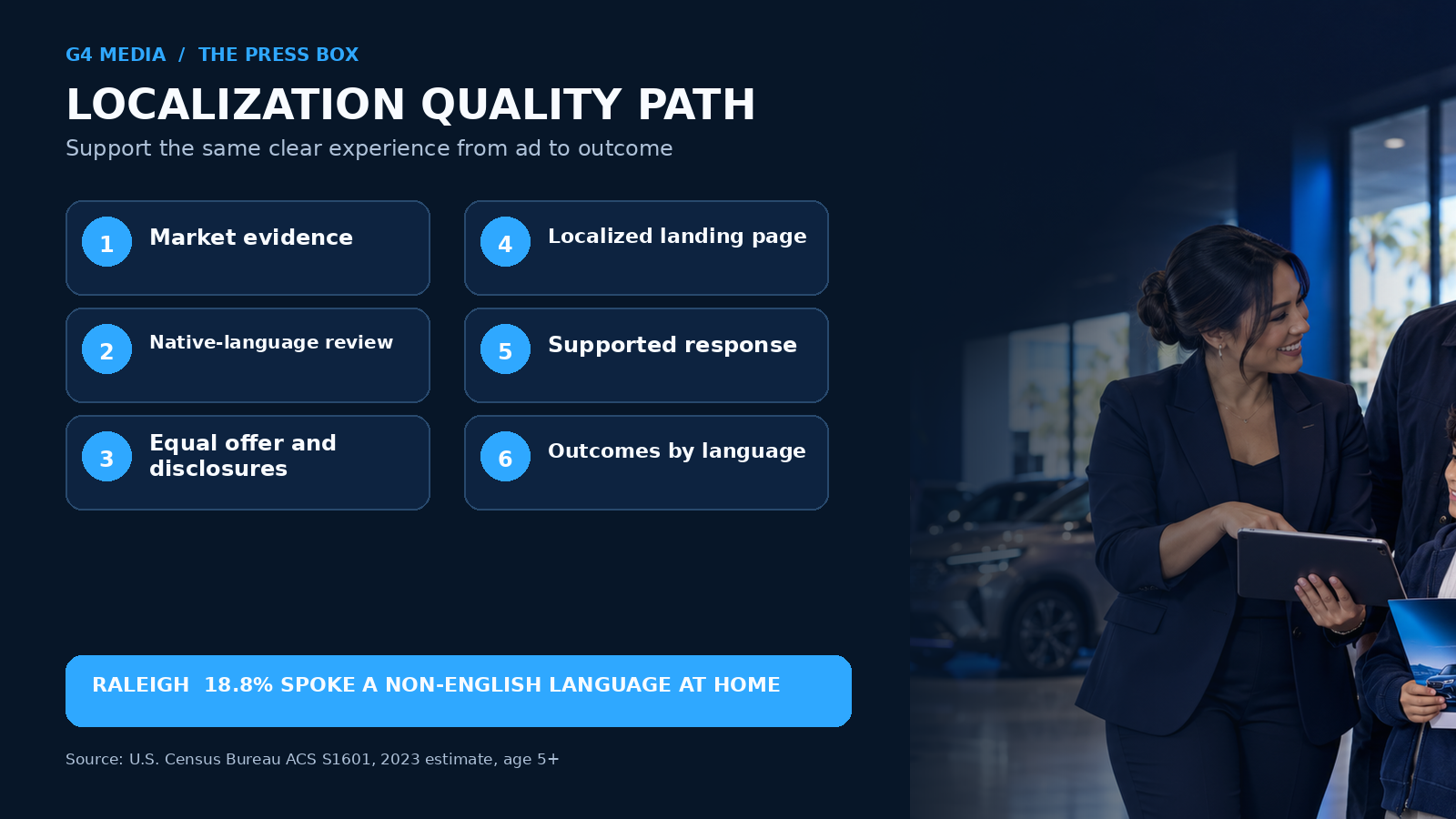
Multilingual dealership marketing works when the entire customer path is localized, not when an English ad is merely translated. The audience definition, offer, disclosures, landing page, form, phone routing, showroom handoff, and follow-up all need to make sense in the customer's language and market context.
For dealerships in Raleigh, this is a measurable planning issue. The U.S. Census Bureau's 2023 American Community Survey estimated that 18.8 percent of Raleigh residents age five and older spoke a language other than English at home; Spanish accounted for 9.5 percent[cite: 1]. Those figures do not tell a dealer whom to target or what any individual prefers, but they do show why English-only planning can overlook part of the local market. Start with reliable market data, use native-language review, preserve the same material offer and disclosures in every language, and ensure a trained person can continue the conversation after someone responds.

Localization Is an Operating Decision
Translation changes words. Localization makes the whole experience usable and credible for a particular audience.
A technically accurate headline can still sound unnatural. A strong ad can still fail when the destination page switches back to English. A bilingual form can still disappoint when the confirmation email, text message, or phone call is not supported in that language. The marketing team therefore needs an operational commitment before it needs a media plan.
Ask five questions at the outset.
-
Which languages appear in authoritative market data and the dealership's consented customer interactions?
-
Can the store support those languages in writing, by phone, and in person?
-
Is the offer equally understandable and materially consistent in each version?
-
Can the dealership identify, route, and respond to a language preference without making assumptions about identity?
-
Will the team measure outcomes by language while protecting privacy and avoiding stereotypes?
The answers should determine campaign scope. If the dealership cannot yet support an end-to-end experience, start with a smaller pilot and fix the response path before expanding reach.
Build the Audience From Evidence
Community data is a planning signal, not a targeting list. Census estimates can indicate that a language deserves research. Customer conversations, approved first-party data, search behavior, media response, and local partnerships can help refine the need. None of those sources should be used to infer a sensitive characteristic about a specific person without a lawful and appropriate basis.
Separate three concepts that are often blended together: the language used at home, the language a customer understands, and the language the customer wants for a transaction. They can be different.
Google Ads, for example, explains that language detection can use search-term language, settings, preferences, and other activity. Its official guidance also notes a change beginning in September 2026 for Search campaigns: campaign-level language targeting is being removed and ad delivery will align more automatically with the language of the creative and landing page. That makes the quality and consistency of each localized experience even more important; it does not remove the dealer's responsibility to choose appropriate audiences, review delivery, or support the response.
Create One Offer With Equal Clarity
The operational offer sheet should exist before any version is written. Record the eligible vehicle or service, price or payment terms, dates, exclusions, required actions, inventory limits, and approval owner. Then create each language version from that same source.
Use a qualified translator or native-language reviewer who understands automotive terms and local usage. Back-translation can reveal meaning that drifted. A second review should compare the creative, landing page, disclosures, form, confirmation message, and BDC script side by side.
Avoid using a different promise, weaker disclosure, or lower-quality destination for one language. Language access should improve clarity, not create a separate standard.
G4 Media direct marketing can coordinate audience, mail format, QR or PURL response, and campaign measurement. G4 digital media can extend the same localized creative and geography across paid channels. The shared brief is what keeps the offer recognizable from mailbox or ad through the response.
Prepare the Human Handoff
Every localized campaign needs a service map. Identify who answers a call, reviews a form, handles a text, greets an appointment, and follows up after a visit. Publish hours and expectations honestly. If live bilingual support is limited, say when a qualified person will respond rather than improvising with a customer in real time.
The CRM should capture a stated communication preference, not an assumption based on a surname, neighborhood, or device setting. Templates should be reviewed, and opt-out or privacy requests should work just as clearly in every supported language.
Measurement should compare delivery, response, qualified leads, appointments, shows, sales or repair orders, response time, opt-outs, complaints, and data gaps. Small samples need cautious interpretation. A lower result may reflect the offer, inventory, staffing, creative, measurement, or market fit; language alone is not a diagnosis.
The G4 Media View
The best multilingual plan is one connected journey. G4 can help align local market data, direct and digital execution, landing experiences, routing, and closed-loop reporting around a consistent offer. That makes the campaign easier to review and the customer experience easier to trust.
Before translating the next ad, map the full response. Talk with G4 Media about a localized campaign that the dealership can support from first impression through final outcome.
Risks and Limits
-
Census estimates describe populations, not individual language preference or purchase intent.
-
Automated translation can miss automotive, cultural, and legal nuance.
-
Language, nationality, ethnicity, and location are not interchangeable targeting concepts.
-
Offers and disclosures require review under applicable federal, state, OEM, lender, platform, and dealer policies.
-
A bilingual ad without a supported landing page or response team can reduce trust.
-
Small language segments can create volatile rates; report counts and context with percentages.
Frequently Asked Questions
Is translation enough for a dealership campaign
No. The offer, disclosure, page, form, confirmation, routing, and human follow-up must work in the same language and context.
How should a dealership choose a language to support
Use authoritative community data, approved customer evidence, operational capacity, and a clear business case. Do not rely on stereotypes or infer an individual's preference from a name.
Can English and Spanish versions use different offers
They can be distinct campaigns, but differences must be intentional, supportable, and reviewed. For one campaign concept, equal material terms are usually easier to govern and compare.
Should a language preference be stored in the CRM
Store a customer-stated preference only when the dealership has an appropriate purpose, notice, controls, and retention practice. Confirm it rather than guessing.
What should the first pilot measure
Measure the complete path: delivered audience, response, qualified lead, appointment, show, sale or repair order, response time, opt-outs, complaints, and missing data.
Sources
-
U.S. Census Bureau ACS table S1601 for Raleigh Official 2023 estimates for language spoken at home[cite: 1].
-
U.S. Census Bureau language-at-home release National context from the 2018 to 2022 American Community Survey.
-
Google Ads guidance on language targeting Official explanation of language signals and the September 2026 Search changes.
Recent Posts