


Aging Inventory Marketing for 30 60 and 90 Day Decisions
Aging Inventory Marketing for 30-, 60- and 90-Day Decisions
The Press Box All the news thats fit to dance to| September 2026 | Draft for Review
Inventory age should trigger a decision, not an automatic discount.
The Short Answer
A 30, 60, and 90-day inventory plan should be a decision cadence, not an automatic discount schedule. At each checkpoint, a dealership should verify the vehicle data, understand the unit economics, diagnose shopper friction, select the next audience and message, and decide whether retailing the vehicle still deserves more time and budget.
The thresholds are planning examples, not universal rules. A seasonal convertible, commercial truck, off-brand trade, and high-volume compact do not share the same turn expectation. The useful principle is escalation: begin with accurate merchandising and a clear market position; add new audiences or creative when evidence supports them; and make a deliberate retail, pricing, transfer, or wholesale decision before aged inventory quietly consumes more carrying cost. Every price and availability claim must remain synchronized across the feed, vehicle detail page, ads, mail, and sales desk.

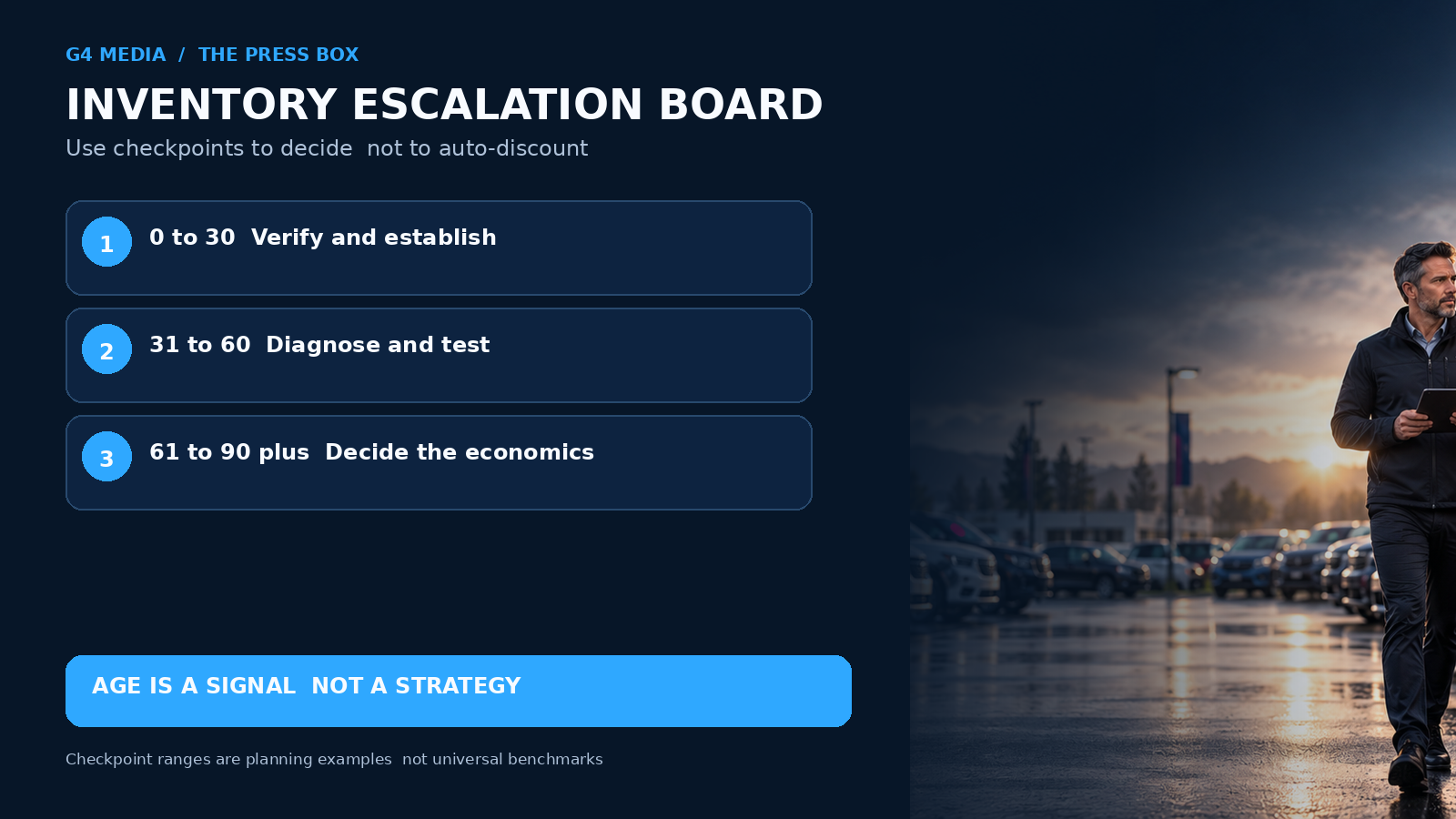
Age Is a Signal Not a Strategy
Days in stock reveal that time has passed. They do not explain why a vehicle has not sold.
Possible causes include the wrong acquisition cost, weak demand, inaccurate vehicle data, poor photos, missing equipment, an uncompetitive price, an unclear value story, a limited audience, an inaccessible landing page, slow lead response, or a vehicle that simply needs more market time. Treating all age as the same problem can lead to unnecessary margin loss or more advertising for a unit that needs a different operational decision.
Create a unit-level record that includes acquisition and reconditioning cost, market position, availability, merchandising completeness, VDP engagement, leads, appointments, shows, offers, price changes, media exposure, and salesperson feedback. The record should be simple enough for a used-vehicle manager, marketing lead, and general manager to review together.
The First 30 Days Establish the Baseline
The first phase is not passive. Confirm the VIN, trim, mileage, features, price, status, images, and landing URL before launch. Google Merchant Center's vehicle-ads policy makes the operational importance explicit: feed and structured-data pricing must match the website landing page, and landing pages must be correct, accessible, and reflect the advertised vehicle[cite: 1].
Give the unit a clear role. Is it a value leader, scarce configuration, certified option, commuter vehicle, family vehicle, work vehicle, or specialty unit? Then select the audience and message that fit that role. Track useful movement such as qualified VDP visits, leads, calls, appointments, and desk activity instead of judging success on impressions alone.
If the vehicle receives attention but no progression, investigate the offer or process. If it receives little qualified attention, investigate market fit, merchandising, audience, or channel.
Days 31 to 60 Require a New Hypothesis
Repeating the same ad with more budget is not an escalation plan. Write down what the first phase taught the team and choose one primary change.
The dealership might expand from customer data to a carefully defined conquest segment, introduce a trade or buyback message, reposition the vehicle around a use case, improve creative, update the landing experience, or change the geographic zone. G4 Media direct marketing offers customer and conquest list strategies plus mail-to-digital response paths. G4 digital media can reinforce the same inventory story in paid channels.
Use a test plan with a start date, audience, message, budget, primary outcome, and stop rule. Change enough to learn, but not so many variables that the result becomes impossible to interpret.
Days 61 to 90 Plus Force the Economic Decision
Later-stage inventory deserves senior review because the tradeoff is no longer just marketing performance. Carrying cost, price position, capital, floorplan, reconditioning, seasonal risk, incoming inventory, and wholesale alternatives all matter.
The team should decide among a limited set of actions: maintain retail position with a documented reason, revise price or offer, create a final targeted push, transfer the unit, or exit it. Marketing can communicate a real advantage. It cannot repair a losing acquisition cost or invent demand.
Avoid false urgency, unavailable prices, or broad claims that cannot be honored. The FTC's March 2026 warning to 97 dealership groups emphasized that advertised vehicle prices must include mandatory fees and identified misleading pricing practices. An aging unit is not permission to weaken offer governance.
Build One Escalation Board
The most useful weekly view combines inventory and customer behavior.
| Checkpoint | Primary question | Evidence | Possible next move |
|---|---|---|---|
| 0 to 30 days | Is the unit accurate and positioned correctly | Feed, VDP, leads, market position | Fix data, creative, price, or baseline audience |
| 31 to 60 days | What hypothesis should change | Engagement and progression by audience | New segment, message, geography, or channel mix |
| 61 to 90 plus | Does more retail time create value | Unit economics and credible demand | Hold, reprice, final push, transfer, or exit |
Report counts and conversion rates together. A low-volume specialty unit needs different interpretation from a high-demand commodity unit. Document why a decision was made so the next acquisition and campaign benefit from the lesson.
The G4 Media View
Aging inventory campaigns work best when the inventory record, audience, creative, channels, landing experience, and final sale data operate as one loop. G4 can help create the direct and digital touchpoints, but the dealership must define the unit economics and operational decision that the campaign serves.
If the aged list keeps growing without a clear decision path, talk with G4 Media about a campaign framework built around inventory age, audience fit, and measurable progression.
Risks and Limits
-
Thirty, sixty, and ninety days are planning checkpoints, not industry performance guarantees.
-
Market days supply, carrying cost, seasonality, franchise rules, and inventory strategy differ by store and vehicle.
-
More exposure does not fix inaccurate data, an inaccessible page, weak follow-up, or poor economics.
-
Price and availability must stay synchronized across every channel.
-
Customer and conquest data require appropriate sourcing, privacy controls, suppression, and retention.
-
Final advertising decisions need applicable legal, OEM, lender, and state review.
Frequently Asked Questions
Should every vehicle be discounted at 30 days
No. Review data, market position, demand, economics, and shopper progression. A discount is one possible decision, not a timer-based requirement.
What should be checked before advertising an aged unit
Verify VIN, trim, mileage, features, photos, price, availability, landing URL, disclosure, contact path, and CRM routing.
When should a dealership expand the audience
Expand when the current audience is too narrow and the vehicle has a credible value story for another segment or geography. Set a test and stop rule.
What is the most important aged-inventory metric
No single metric is enough. Combine unit economics with qualified progression from VDP engagement through lead, appointment, show, offer, and sale.
Can marketing solve every aged-inventory problem
No. Some units require a pricing, acquisition, reconditioning, transfer, or wholesale decision rather than another campaign.
Sources
-
Google Merchant Center vehicle ads policies Official requirements for feed accuracy, matching prices, accessible landing pages, and availability[cite: 1].
-
FTC warning to 97 auto dealership groups March 2026 reminder about advertised price and deceptive practices.
-
NHTSA VIN decoder Official VIN decoding resource for vehicle-data verification.
Recent Posts