



Real-Time Trigger Leads: How Do You Reach Auto Shoppers Before the Competition Does
The Short Answer
Real-time trigger leads can help a dealership reach shoppers during a meaningful decision window, but speed is not the first control. The dealer must know what the signal means, whether it can be used for the intended purpose, which consumers and offers qualify, who owns the response, and how the outcome will be measured. When consumer-report information is involved, a “soft” inquiry may not affect a credit score, but that does not make the data permission-free. Permissible-purpose, prescreen, notice, opt-out, fair-lending, channel, and state-law requirements need qualified legal and compliance review before launch.
A Trigger Is a Signal, Not a Customer
The appeal is obvious: intent decays. A consumer who has just entered a shopping or credit-related process may be more receptive than someone reached weeks later. But a signal can be misunderstood. It may indicate a prescreening event, a general category of activity, a returning site visitor, a service milestone, or a partner-defined behavior. None of those automatically proves that a person wants a specific dealership to call.
A well-designed real-time trigger lead program translates the signal into an approved action. The translation must be documented: signal definition, source, permissible use, consumer criteria, offer, channel, timing, suppression rules, and owner.
The Five Controls
| Control | Operational Question | Failure Mode | Required Owner |
|---|---|---|---|
| 1. Permission | Can this data be used for this person, purpose, offer, and channel? | A fast campaign is launched on an assumption instead of an approved basis. | Legal/compliance plus data owner. |
| 2. Qualificationc | Which geography, vehicle, credit, age, suppression, and capacity rules apply? | The store receives volume it cannot serve or offers it cannot honor. | Marketing, sales, finance, compliance. |
| 3. Relevance | What message is appropriate to what is actually known? | Outreach reveals or overstates sensitive inferences and damages trust. | Marketing and compliance. |
| 4. Response | Who acts, by when, with which script and escalation path? | Signals sit in a queue, receive duplicate contact, or lack an owner. | BDC/sales operations. |
| 5. Measurement | How will source, contact, appointment, sale, opt-out, and complaint be reconciled? | The program is judged by raw lead count and cannot improve. | Marketing operations and CRM owner. |
Understand “Soft” Before You Say “Safe”
The Consumer Financial Protection Bureau explains that soft inquiries do not affect credit scores. It also states that no one should request a credit report without a valid purpose allowed by law. Those statements belong together. Score impact describes what the inquiry does to the consumer’s score; permissible purpose governs whether a report may be obtained or used. The CFPB’s advisory opinion further emphasizes that permissible purposes under the Fair Credit Reporting Act are consumer-specific.
If a program relies on prescreening for a credit offer, the offer, selection criteria, disclosures, opt-out language, fulfillment process, and recordkeeping must be configured for that use. Do not convert a vendor’s general statement—“soft pull,” “prequalified,” or “intent signal”—into a legal conclusion. Ask counsel to review the actual data flow, contract, selection logic, creative, channel, and operating procedure.
Build the Offer Around What You Can Support
A trigger campaign should promise only what the dealership can consistently deliver. Separate these concepts in the copy and workflow:
- Invitation to learn more: a marketing message that does not imply approval.
- Prescreened offer: an offer governed by specific criteria, notices, and opt-out requirements.
- Prequalification or qualification language: terminology that must match the actual process and legal review.
- Credit application or final terms: a later process with its own disclosures, verification, underwriting, and adverse-action obligations where applicable.
Train the BDC and sales team on the exact distinction. A compliant creative review can still fail if an employee improvises a promise the offer does not support.
Speed Requires a Service-Level Agreement
“Real-time” should describe the system, not a vague aspiration. Define the clock: when the signal is received, when it is accepted into the CRM, when the first approved action occurs, and when it escalates. If the store is closed, specify the after-hours experience. If a consumer responds, stop generic automation and transfer context to a person. If the record is duplicated or suppressed, prevent competing outreach.
Connect the signal to the dealership’s
lead conversion and identity resolution workflow so identity, consent, source, offer, owner, and status travel together. If mail is part of the approved offer, coordinate it with
direct marketing rather than treating the letter and phone call as unrelated campaigns.
The G4 Media View: Target, Filter, Capture, Coordinate
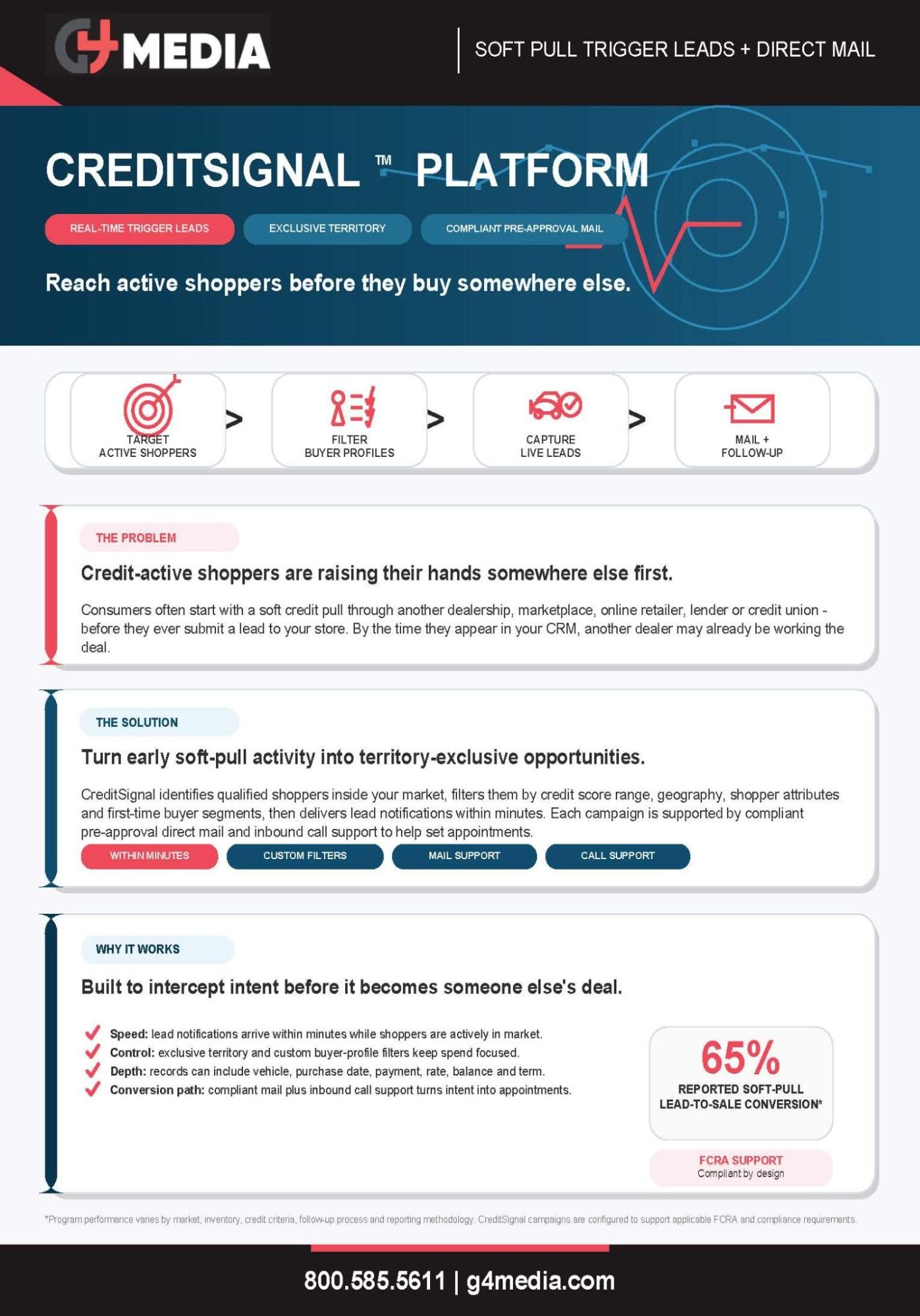
G4 Media’s CreditSignal collateral describes four useful operating ideas: define the target, apply custom filters, capture qualifying activity, and coordinate mail with call or digital follow-up. The value is not the label on the signal. It is the discipline that narrows the signal to a serviceable audience and gives the store an accountable next action. Territory and exclusivity claims, where offered, should be written into the agreement and validated against the actual program configuration.
Measurement That Protects the Program
Report quality and risk together. Useful fields include signal date, source, eligibility result, suppression result, offer version, assigned owner, first-action time, contact disposition, appointment, show, sale, opt-out, complaint, return mail, and matchback status. Review exceptions, not only averages. One complaint caused by a misleading inference can reveal a process problem that a strong response-time dashboard misses.
Risks and Limits
- Do not infer or reveal sensitive credit details in outreach beyond what the approved offer and law allow.
- Do not use the word “approved” when the consumer has not completed the required process.
- Do not contact records that fail suppression, territory, capacity, or offer criteria.
- Do not rely on a vendor contract as the only compliance control; test the configuration and frontline execution.
- Do not publish performance claims without the funnel definitions, cohort, time period, market, offer, and matchback method.
Frequently Asked Questions
Does a soft inquiry affect a consumer’s credit score?
The CFPB says soft inquiries do not affect credit scores. That fact does not answer whether a company has permissible purpose to obtain or use consumer-report information.
Is a trigger lead the same as an application?
No. A signal, a prescreened offer, an inquiry, and a completed credit application are different events. The CRM and script should preserve those distinctions.
How fast should a dealership respond?
Set an achievable service-level agreement by channel and business hours, then measure it. Relevance, accuracy, suppression, and ownership matter more than claiming an arbitrary number of minutes.
Can the same signal be shared with several dealers?
That depends on the provider and agreement. If territory or exclusivity matters, define it in writing and verify how duplicates, radius, brand, and timing are enforced.
What should be reviewed before launch?
Data source, permissible purpose, selection criteria, creative, firm-offer and notice requirements where applicable, opt-out, channel rules, suppression, fair-lending risk, state law, scripts, data security, recordkeeping, and measurement.
Make the Signal Actionable
If your dealership is evaluating trigger leads, start with the operating model—not a lead-volume promise. Ask G4 Media to map the trigger-to-sale workflow with your marketing, BDC, finance, and compliance stakeholders.
Sources
- CFPB: What is a credit inquiry? — Official explanation of hard and soft inquiries and score impact.
- CFPB: Permissible purposes for furnishing, using, and obtaining consumer reports — Official advisory opinion on consumer-specific permissible purpose.
- FTC: Prescreen Opt-Out Notice Rule — Official rule resource for prescreened credit and insurance offers.
Recent Posts