
Is Direct Mail Dead—Nope! It Just Needs a Digital Dance Partner
The Short Answer
Direct mail becomes more useful when it is planned as the first physical touch in a connected campaign. The piece should have one clear audience, one credible offer, and one easy response path. A memorable URL or QR code sends the recipient to a message-matched landing page; campaign parameters and call tracking identify the response source; permitted email and social audiences reinforce the offer; the CRM assigns follow-up; and sales matchback tests the business result. Digital does not rescue weak mail. It gives a strong piece continuity, convenience, and measurement.
Why the Mailbox Still Has a Job
A physical piece can create a different kind of attention than another feed impression. It can sit on a counter, reach a household, carry a tactile signal, or make a local event feel tangible. The U.S. Postal Service continues to offer tools such as Every Door Direct Mail for targeting neighborhoods and routes. The strategic question is not whether mail is “alive” in the abstract. It is whether a specific audience, offer, format, and follow-up path justify the cost for this dealership.
G4 Media’s direct marketing program treats mail as one channel in an addressable campaign. That is the right frame: use physical creative for the opening beat, then let the customer choose phone, web, email, or an in-store action.
The Mail-Plus-Digital Blueprint
| Touchpoint | Its Job | Control to Define | Primary Measure |
|---|---|---|---|
| Audience and list | Reach people the store can serve | Source, permission, geography, suppression, deduplication, offer eligibility. | Deliverable records and eligible households. |
| Mail piece | Earn attention and explain one next step | Format, message, offer, terms, expiration, brand, accessibility. | Delivered quantity, return mail, response. |
| QR / URL / phone | Make response easy | Unique destination, UTM convention, readable URL, tracked number, fallback path. | Scans, visits, calls, qualified actions. |
| Landing page | Continue the exact promise | Message match, mobile speed, form value exchange, consent, inventory or appointment path. | Key events, completion, abandonment. |
| Email / social | Reinforce without contradicting | Approved list use, audience policy, creative sequence, frequency, suppression. | Reach, engagement, assisted response. |
| CRM and matchback | Own the response and learn | Routing, SLA, dispositions, sale matching, attribution window. | Contact, appointment, show, sale, opt-out. |
One Campaign, Not Six Loose Tactics
A coordinated campaign uses the same audience definition, offer version, dates, and naming convention across mail, landing pages, email, social, calls, and CRM. That sounds simple, but mismatches are common: the postcard advertises one vehicle, the QR code opens a generic homepage, the call center sees no campaign context, and the sales report cannot distinguish the response from an existing lead.
- Create one campaign ID and carry it through the list, print file, QR destination, UTM parameters, tracked phone number, form, and CRM source.
- Use a landing page that repeats the headline, offer, qualification, and expiration visible on the piece.
- Give the BDC the mailed audience, creative, approved script, common questions, and offer exceptions before the first drop.
- Schedule digital reinforcement around expected in-home timing, then suppress people who convert, opt out, or become ineligible.
- Predefine the attribution window and matchback method. Report direct response, assisted response, and control-group lift separately when the design supports it.

The Creative Still Has to Earn the Scan
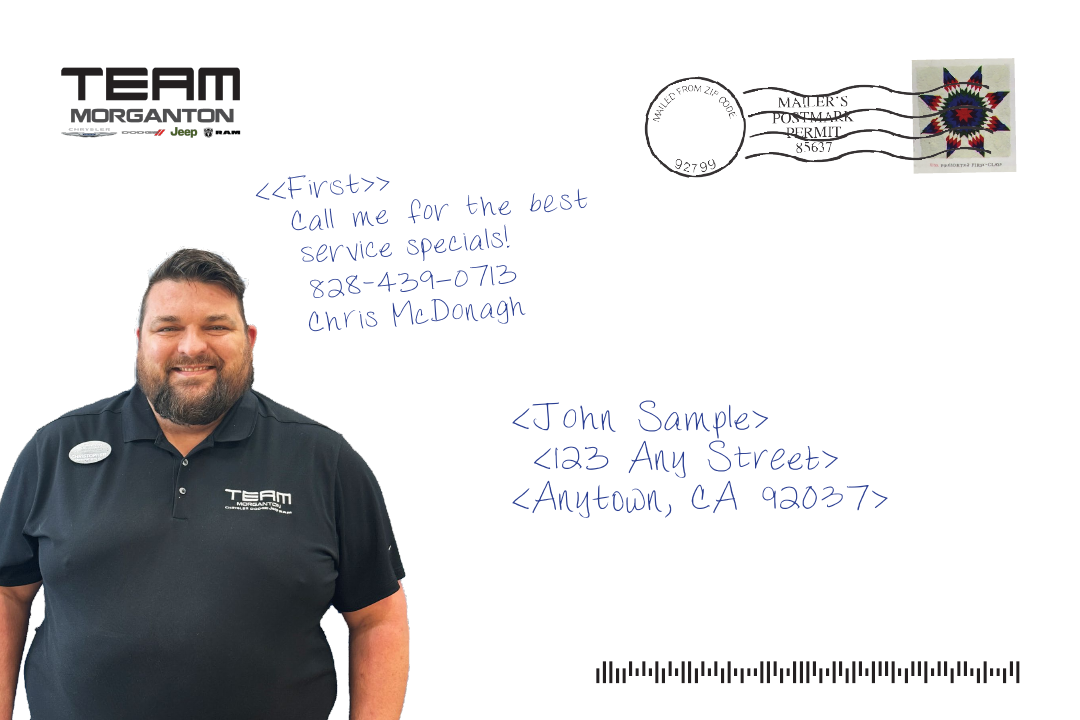
The supplied handwritten postcard example demonstrates two useful principles: a personal-looking opening and a direct next step. The format may earn a second look, but the message still needs commercial discipline. State why the recipient is receiving it, make the offer understandable, disclose important qualifications, and give the reader a path that does not depend only on scanning a code.
Avoid fake intimacy. If the note is produced at scale, do not claim that a named employee personally wrote it unless that is true. Personalization should improve relevance, not misrepresent how the piece was created.
Use Digital to Continue, Not Crowd, the Message
Google Analytics documents how UTM parameters can identify campaign traffic. Meta describes customer-list custom audiences as a way to reach people who have already shown interest, subject to its terms and the advertiser’s lawful use of the list. Those tools support continuity, but they do not eliminate the need for notice, permission, suppression, security, and platform-policy review. Coordinate the campaign through digital media with a frequency plan and one source of truth for creative and status.
A useful sequence might be: mail arrives; the recipient scans or types the URL; the landing page answers the offer; a consented response enters the CRM; digital ads reinforce the same message; email handles requested follow-up; and sales outcomes return to the campaign report. Each step should stop or change when the person responds.
Measurement Without Attribution Theater
A QR scan is a response, not automatically a sale. Report the funnel: delivered mail, returned mail, visits, calls, key events, leads, qualified leads, appointments, shows, sales, opt-outs, and complaints. Deduplicate people who respond through multiple paths. When possible, use a holdout or matched control to estimate lift; otherwise label matchback as association rather than proof that mail caused every sale.
Risks and Limits
- Do not upload a customer list to an advertising platform without confirming permitted use, notice, contracts, security, and suppression.
- Do not send a QR code to the homepage. Use a dedicated, secure, mobile-friendly, message-matched destination.
- Do not hide material offer terms in tiny print or only inside an image.
- Do not assume every household member is the intended recipient; avoid sensitive personalization on an exposed postcard.
- Do not call a matchback sale incremental unless the campaign design supports that conclusion.
Frequently Asked Questions
Should every mail piece include a QR code?
Only if the code leads to a useful, tested, mobile path. Also provide a readable URL or phone alternative and track each response route.
What should the landing page contain?
Repeat the campaign promise, show qualifications and expiration, answer the likely question, give a clear next step, and collect only the information needed for that step.
Can dealers retarget the mailing list?
Potentially, but the dealer must confirm lawful and contractually permitted list use, platform rules, notice, suppression, and security. Customer-list matching is not a blanket permission.
How should direct-mail ROI be measured?
Define costs and conversion stages before launch, deduplicate responses, reconcile CRM outcomes, and distinguish response, matchback, and incremental lift.
When does handwritten-style mail make sense?
When the audience, brand, and message benefit from a personal tone—and when the creative remains truthful, readable, compliant, and scalable.
Choreograph the Whole Campaign
If mail is one of your store’s strongest attention tools, give it a measurable digital path. Ask G4 Media to build a mail-plus-digital test with one audience, one offer, and one scorecard.
Sources
- USPS: Every Door Direct Mail — Official overview of route and neighborhood targeting for local mail campaigns.
- Google Analytics: Collect campaign data with custom URLs — Official UTM parameter guidance for campaign reporting.
- Meta Business Help: Customer List Custom Audiences — Official overview of matching an advertiser-provided customer list to Meta audiences.
Recent Posts