


Search Has Changed: How Dealerships Earn Visibility in AI Answers
The Short Answer
Dealerships earn visibility in AI-generated search answers by publishing content that is specific enough to solve a shopper’s question, technically accessible to search engines, supported by real evidence, and connected to a recognizable local business. Google’s own guidance says the familiar fundamentals still apply: helpful content, crawlability, internal links, strong page experience, and accurate structured information. There is no special AI-only markup that substitutes for those basics. The practical shift is that one short keyword page is rarely enough; dealers need complete, locally grounded answers that can support the follow-up questions an AI system may explore.
Why This Matters to Dealers
A shopper may still type “SUV lease near me,” but increasingly the journey also includes questions such as “Which three-row SUV fits two car seats?” or “What should I expect to pay for maintenance on a used hybrid?” AI search experiences can synthesize information across several pages before displaying an answer. Google describes this as a process that may issue multiple related searches—sometimes called query fan-out—to gather supporting information. That means a dealership must be discoverable for the original query and useful across the surrounding decision.
This does not make traditional search engine optimization obsolete. It makes thin, duplicated, or generic pages less defensible. The opportunity belongs to dealers that can explain what is true in their market: real inventory choices, ownership considerations, service knowledge, finance terminology, local driving conditions, and the tradeoffs buyers actually face.
The Four-Layer Visibility System
| Layer | Question to Answer | Dealer Action | Evidence to Monitor |
|---|---|---|---|
| 1. Eligible | Can search systems crawl, index, and understand the page? | Use descriptive titles, crawlable links, clean templates, canonical signals, and accurate structured data. | Indexing status, crawl errors, page experience, canonical coverage. |
| 2. Useful | Does the page answer the shopper’s real question? | Lead with the answer; cover comparisons, costs, constraints, next steps, and local context. | Engaged visits, scroll depth, calls, forms, inventory views. |
| 3. Credible | Why should this dealership be trusted? | Name the author or reviewer, show update dates, cite primary sources, and include first-hand dealership knowledge. | Author coverage, source freshness, content reviews, customer questions resolved. |
| 4. Measurable | Can the team connect visibility to outcomes? | Track landing pages, key events, assisted visits, lead quality, appointments, and closed sales where permitted. | Search visibility, qualified actions, CRM stages, matchback. |
What to Publish First
Start with questions that already cost the store time or create uncertainty for buyers. Good candidates include:
- Model and trim comparisons that explain who each option is for—not a rewritten brochure.
- Financing and leasing explainers reviewed by the appropriate compliance or finance leader.
- Service questions that use the dealership’s actual process, climate, roads, and ownership patterns.
- Used-vehicle buying guides that explain inspections, reconditioning, warranties, and realistic tradeoffs.
- Local ownership pages that connect vehicles to towing, weather, commutes, parking, charging, or family needs.
A 30-Day Execution Plan
- Inventory the questions. Pull questions from sales calls, service advisors, site search, chat transcripts, paid-search terms, and showroom conversations. Group them by shopping stage.
- Choose one answer owner. Assign a knowledgeable employee or approved subject-matter reviewer to each cluster. Capture what the store sees in practice, including limits and exceptions.
- Build answer-first pages. State the practical answer near the top, then add explanation, comparisons, risks, a next step, and links to related dealership resources.
- Connect the site. Use contextual internal links so a shopper—and a crawler—can move from an educational answer to inventory, finance, service, case studies, or contact information.
- Measure business actions. Track visibility, but also watch the actions that matter: inventory engagement, calls, appointments, qualified leads, and eventual sales matchback.
The G4 Media View: Build the Whole Story
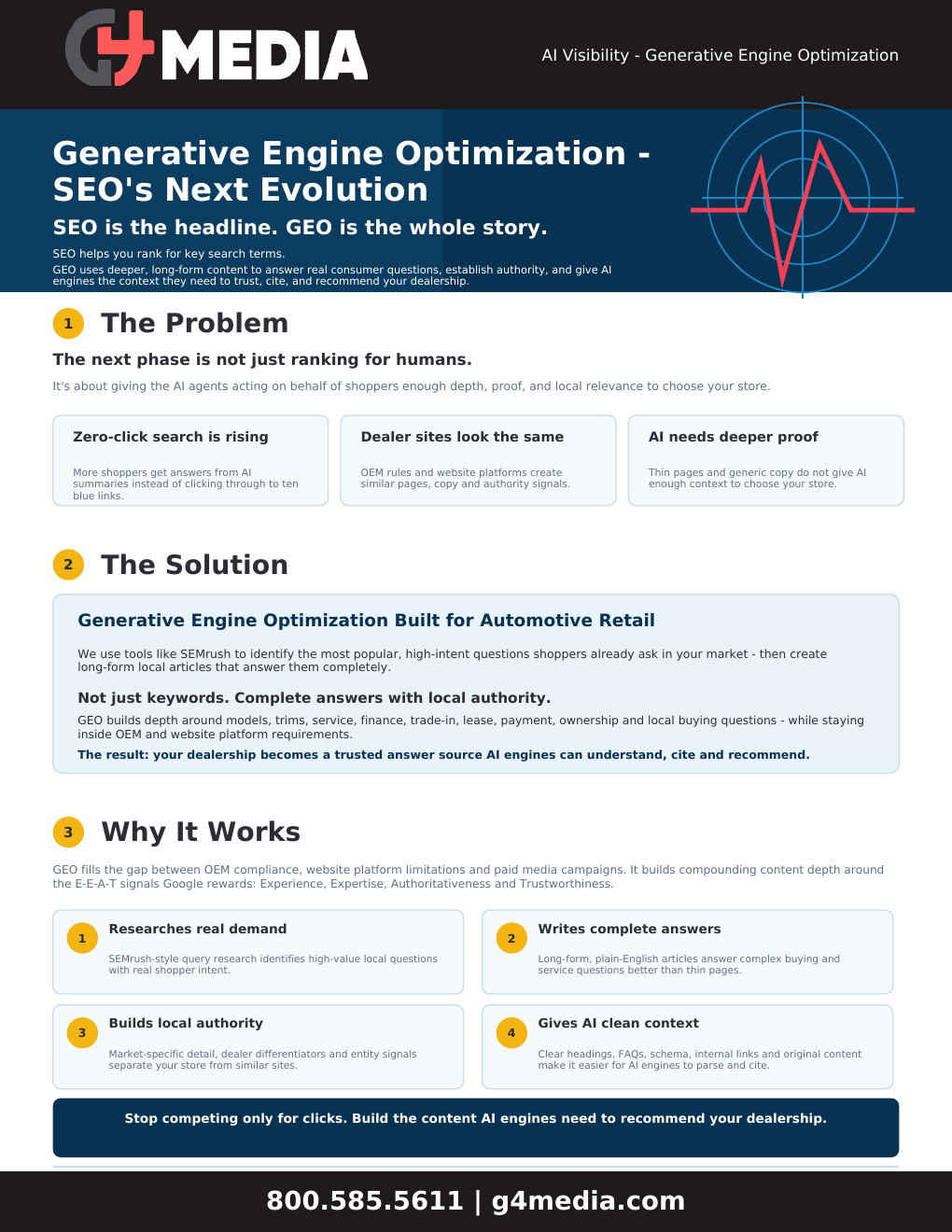
G4 Media’s supplied GEO framework makes a useful distinction: an SEO page may earn attention with a headline, while AI visibility requires the surrounding story. For a dealership, that story should combine local long-form content, first-hand expertise, FAQs, internal links, accurate markup, and distribution across the channels where customers encounter the brand. The strongest version is not an article factory. It is a repeatable editorial system tied to real shopper questions and reviewed by people who know the store.
That system should also connect with the dealership’s digital media strategy. Search content can introduce the answer, while paid media, email, social, and retargeting continue the conversation. Verified dealer marketing results can then show which topics and journeys contribute to appointments and sales.
Risks and Limits
- Do not publish manufacturer, incentive, finance, warranty, or availability claims without a current source and an owner for updates.
- Do not turn every page into the same templated paragraph with a city or model name swapped in. Duplication weakens usefulness and can create maintenance problems.
- Do not hide important answers behind forms. Give the reader enough value before asking for contact information.
- Do not measure success only by whether a brand appears in one AI answer. Results vary by query, location, system, and time; business outcomes matter more than screenshots.
- Do not outsource experience. AI can assist production, but the differentiating facts should come from the dealership and be reviewed by a responsible person.
How G4 Media Can Help
G4 Media can help turn dealership expertise into a governed search and content program: question research, editorial planning, local answer development, technical coordination, internal linking, distribution, and measurement. The useful first step is a visibility audit that identifies what shoppers ask, which answers already exist, and where the dealership lacks a credible page to support the decision.
Frequently Asked Questions
Is GEO different from SEO?
The labels describe different emphases, but the work overlaps. Google says the same SEO fundamentals remain relevant to its generative search features. “GEO” is most useful as a planning lens for complete, answer-ready content—not as a replacement for technical SEO.
Do dealerships need special AI schema?
No special AI schema is required. Use supported structured data accurately, keep visible page content consistent with the markup, and focus on crawlability and helpful information.
Should every inventory page be rewritten?
Not automatically. Prioritize pages where unique condition, equipment, reconditioning, ownership context, or local demand genuinely helps a shopper. At scale, accuracy and governance matter as much as volume.
How long until AI visibility improves?
There is no fixed timeline or guaranteed inclusion. Crawlability, site authority, content quality, competition, and query demand all influence discovery. Set review checkpoints and measure qualified actions instead of promising a date.
What should a dealership measure?
Track search visibility and landing-page engagement, then connect those signals to meaningful key events, qualified leads, appointments, and closed business where the data and permissions support it.
Turn Questions Into Visibility
Want to see where your dealership is missing answer-ready content? Talk with G4 Media about a practical AI visibility and discovery audit.
Sources
- Google Search Central: Optimizing your website for generative AI features — Official guidance on SEO fundamentals, query fan-out, technical access, content quality, and measurement.
- Google Search Central: Creating helpful, reliable, people-first content — Official quality and trust questions for content creators.
- Google Search Central: Article structured data — Official implementation guidance for article markup.
Recent Posts